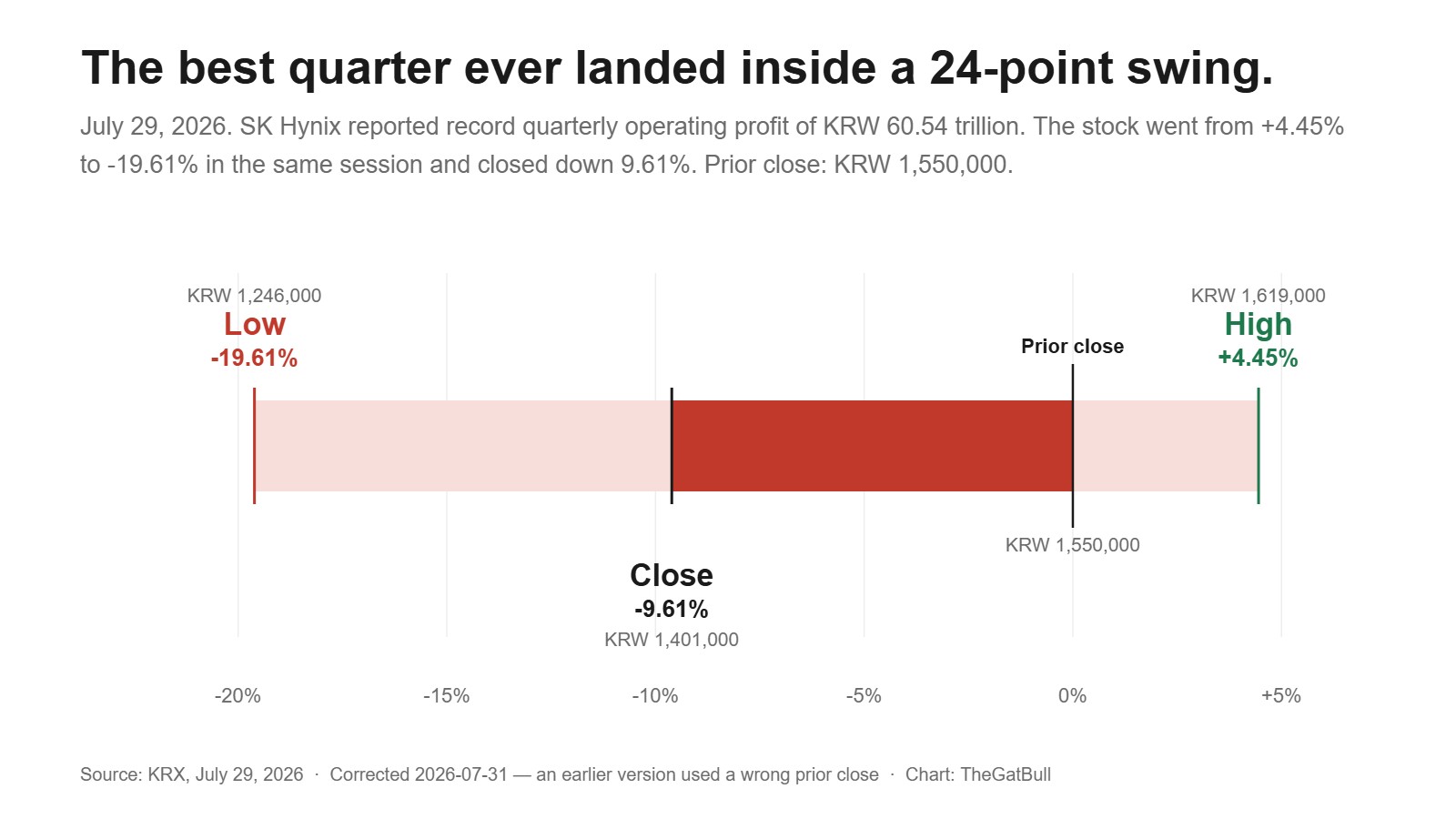
Correction — July 31, 2026. The percentage moves in an earlier version of this article were calculated against the wrong prior close. SK Hynix closed July 28 at ₩1,550,000, not the figure we used. The corrected moves for July 29 are: high +4.45%, low −19.61%, close ₩1,401,000, down 9.61%, following a 14.65% drop on July 28 — a two-day decline of 22.85%. We had published −7.54%, −16.16% and 22.5%. The chart and the headline have been rebuilt. Prices quoted for the intraday high and low are unchanged; only the percentages and the closing price were wrong. The article’s argument — that a record quarter was sold because of what the guidance did not contain — is unaffected, and the two-day decline was in fact slightly larger than we reported.
Before the market opened on Wednesday, July 29, SK Hynix reported its second quarter. Revenue of ₩79.32 trillion, operating profit of ₩60.54 trillion — up 256.8% and 557.2% from a year earlier. Both were quarterly records. First-half revenue reached ₩131.90 trillion, crossing ₩100 trillion for the first time in the company’s history.
The market read it that way at first. The stock touched ₩1,619,000 — up 4.45%.
Later the same session, the same stock traded at ₩1,246,000. Down 19.61%.
That is a 24.06-point swing inside one day. It closed at ₩1,401,000, down 9.61%, following Tuesday’s 14.65% drop — a two-day decline of 22.85%.
Volume was 23.17 million shares, 2.1 times the 20-day average. Market capitalization fell below ₩1,000 trillion for the first time since April 30, printing ₩959.87 trillion in the early afternoon. Measured from the June 23 high of ₩3,002,000, the stock is down 53% — roughly half its value in about five weeks.
The KOSPI fell 360.42 points, or 5.98%, to 5,663.24. Sell-side sidecars triggered on both the KOSPI and the KOSDAQ for a second consecutive session.
All of this on the day the company announced the best quarter it has ever had.
What this means for SKHY and global memory holders
1. The market did not reject the Q2 numbers — that quarter was already in the price.
2. What got sold today was the second half. The company said very little about it in confirmed terms, and no shareholder return package came with the release.
Won figures convert at USD/KRW 1,451.76, the Seoul close on July 29, 2026 — down 10.74 won from Tuesday, a second straight day of won strength. This is one person’s view, not advice.
Three things the market wanted. It got none of them.
“Good earnings, stock down” explains nothing on its own. The useful question is what was expected and what failed to arrive. Three things were on the list.
1. Visibility into the second half. Not delivered. The company said it expects second-half bit growth to exceed the first half, and that it plans to expand HBM4 production in earnest. Those are directions, not numbers.
2. Shareholder returns. Not delivered. Record results arrived with no separate buyback or dividend package — one of the reasons Korean media cited for the selloff. When a company earns ₩60 trillion in a quarter and says nothing about what happens to the cash, the question doesn’t go away. It just moves to the next quarter.
3. An answer on China. Not delivered, and arguably not the venue for one. What broke the market on Tuesday was not earnings — it was a report that China has begun developing its own DUV lithography equipment, plus the Shanghai listing of Chinese memory maker CXMT.
With all three missing, what remained was a single fact: the quarter that already happened was good. That was already priced.
How a decline printed in Seoul gets recalculated on its way to a dollar account — I worked through the arithmetic in yesterday’s piece. The won strengthened again today, which softens the loss for U.S. holders for a second straight session.
🎩 Under the Gat — An earnings release is not a place to confirm the past. It’s a place to sell the future. The profit from a finished quarter is mostly in the price before the release goes out, which is why the “record” label carries less weight than it sounds like it should. Today the company didn’t have the thing that was actually for sale — a confirmed account of the second half — and the market priced that precisely. Calling the reaction irrational is the lazy read.
The miss, and the sentence that explains it
The record quarter came with a footnote. Consensus operating profit was ₩63.55 trillion. The company came in 4.7% below it.
And it named the reason:
“Shipment timing was pushed back on some high-value products.”
That is not a statement about demand disappearing. It says goods that will sell did not ship inside the quarter. The company added that it expects the drag to ease through the second half.
The distinction matters. Tuesday’s collapse ran on the story that demand breaks. Today’s stated reason was that shipping slipped. Those are different claims, and under the second one the missing volume moved to a later ledger rather than vanishing.
It didn’t defend the stock, though, and the reason is simple: “pushed into the second half” is a claim that only Q3 results can settle. That verification is a quarter away, and the China question sits there the whole time.
What we said on July 20 we would watch
Nine days before the release, I set out what to check this quarter. Here is the answer key.
| What we said we’d watch (Jul 20) | What arrived |
|---|---|
| Where operating profit lands in the consensus range | ₩60.5tn — the low end, 4.7% below consensus |
| Whether HBM4 actually ramped in Q2 | Mass-production shipments began ✅ — full expansion is a second-half plan |
| Whether the margin record held | Revenue and operating profit both all-time quarterly highs |
| The tone of forward guidance | Bit growth “expected” higher in H2 · CapEx discipline maintained |
| (not on the list) | Shareholder returns — nothing announced |
What we decided to watch and why, and how the brokerage estimates split, is in the pre-earnings checkpoint. This piece is the answer key to it.
Three of the four went roughly to plan. But the fifth line — the one that wasn’t on our list — did the most damage today. Writing the preview, we asked about the quality of the earnings. We never asked what the company would do with them.
“CapEx discipline” was not a comfort today
What a company declines to do deserves the same weight as what it does. SK Hynix said it will maintain CapEx discipline — fab construction, equipment installation and capacity expansion will proceed in stages, judged against demand visibility and investment efficiency.
When a memory maker talks about discipline in the middle of a boom, it usually means one of two things. Either the memory of oversupply is still fresh, or conviction about the durability of demand isn’t there yet.
Structurally, that runs against the thing the market was afraid of on Tuesday. If you genuinely expected Chinese supply to flood in, you would build ahead of it, not wait for demand to prove itself.
The market didn’t read it that way today. The same sentence supports “supply discipline” and “demand uncertainty” equally well. In a selloff, it gets read the second way.
A window opened quietly the same day
Buried under the earnings, today was a turning point for a different reason if you hold Korea from a U.S. account. Two-way conversion between SK Hynix’s Korean common shares and its Nasdaq-listed ADRs (SKHY) opened on July 29.
The mechanics: ten ADSs equal one common share. The premium between the Seoul price and the ADR has run as wide as 51% and sat in the low 30s recently. With a conversion window open, arbitrage should in theory compress it.
One condition, though: conversion is capped at 2.5% of shares outstanding. The corridor is open, but its width is fixed.
Why the ADR premium exists in the first place and what sustains it is laid out here.
🎩 Under the Gat — Of all weeks, the conversion window opened during one where the Seoul shares fell 22.85% in two sessions. A premium is a ratio between two prices, so when the denominator collapses the premium can widen rather than close. Today’s SKHY move contains the earnings reaction, the conversion opening, and the Seoul crash all at once. One day of data won’t separate them.
Counting the day
A record quarter was announced. Consensus was missed by 4.7%, on shipping timing rather than demand. No shareholder return package came with it. The stock rose 4.45%, fell 19.61%, and closed down 9.61% — a two-day decline of 22.85% that took market capitalization below ₩1,000 trillion and left the shares 52% below their June closing high of ₩2,919,000.
Put together: the market didn’t reject the second quarter. It hasn’t bought the second half.
The company made three claims about that half — shipment delays easing, HBM4 expanding in earnest, bit growth exceeding the first half. All three are checkable, and all three are still promises. When Q3 numbers arrive, that’s when this week’s 22.85% gets classified as overreaction or as a market that saw it early.
This article is a personal opinion written for informational purposes. It is not financial advice and not a solicitation to buy or sell. Securities mentioned are examples, not recommendations. Earnings figures follow SK Hynix’s Q2 2026 disclosure; share prices are closing values unless labelled otherwise. FX basis: USD/KRW 1,451.76, Seoul close, July 29, 2026. Index figures are KRX values. Responsibility for investment decisions and their outcomes rests with the investor.
FAQ
Why did SK Hynix stock fall after record earnings?
On July 29, 2026 SK Hynix reported record quarterly operating profit of ₩60.54 trillion. The stock rose as high as ₩1,619,000 (+4.45%), fell as low as ₩1,246,000 (−19.61%), and closed at ₩1,401,000, down 9.61%. What the market wanted to confirm was not the finished quarter but three forward items — second-half visibility, shareholder returns, and an answer on Chinese competition. None arrived in confirmed form.
Did SK Hynix beat earnings in Q2 2026?
No. Revenue of ₩79.32 trillion and operating profit of ₩60.54 trillion were both all-time quarterly records, but operating profit came in 4.7% below the ₩63.55 trillion consensus.
Why did earnings miss consensus?
The company cited delayed shipment timing on some high-value products — volume that did not ship within the quarter rather than demand that disappeared. It expects the drag to ease through the second half.
When does HBM4 ramp up?
Mass-production shipments began in the second quarter. Full expansion is scheduled for the second half, and the company expects second-half bit growth to exceed the first half.
Can SK Hynix ADRs be converted into Korean shares?
Two-way conversion opened on July 29, 2026. Ten ADSs equal one common share, and conversion is capped at 2.5% of shares outstanding. The ADR premium has run as wide as 51% and sat in the low 30s recently.
How far have Korean chip stocks fallen this week?
SK Hynix fell 14.65% on July 28 and 9.61% on July 29 — 22.85% over two sessions — taking market capitalization below ₩1,000 trillion for the first time since April 30. From the June 23 high of ₩3,002,000 the stock is down 53%. The KOSPI fell 10.84% and 5.98% on the same two days, with sell-side sidecars triggering both sessions.