This article is for informational purposes only and is not financial advice. TheGatBull may earn a commission from some links at no cost to you — see our disclosure and full disclaimer.
This is not financial advice — a view from Seoul, not a recommendation to buy or sell anything. (All index and currency levels are Korea Exchange regular-session closes at 3:30 p.m. KST, or Seoul spot-market closes at 3:30 p.m., on the date given. Where a figure belongs to a US- or Japan-based instrument or statement, it is labeled by that market’s trading day.)
Nothing said by officials in Korea, the United States or Japan this week moved the market. But lay the week’s statements out in order and the argument now surrounding the Korean stock market becomes visible. In the week of August 3, Seoul for the first time named foreign press coverage and answered it, Washington called the Korean won by name, and Tokyo published a ledger showing that its July intervention totaled zero.
Three capitals spoke about the Korean market. None of it was assembled in English.
This column carries those statements over. It does not judge whether they are right. It records who said what, when, and how firmly that statement is confirmed.
1. The week’s statements, August 3–8, 2026
Confirmation strength: On the record means a named official speaking publicly. Reported, not confirmed means media relay only. Not confirmed means no first-party source exists. Symbols in tables are secondary — the words carry the meaning.
Korea
August 6, 9:14 a.m. — Koo Yun-cheol, Deputy Prime Minister and Minister of Economy and Finance, at an emergency economic headquarters meeting at the Government Complex in Seoul:
“The Korean economy is more solid than at any time before and is delivering unprecedented results.” / “Growth, exports, prices, consumption and the business sentiment index — both real activity and macro indicators are firm.” / “The government is responding rapidly to reduce stock market volatility, and recently the index has also been on a stabilizing trend.”
The last sentence was delivered as an answer to foreign press coverage that had questioned investing in the Korean stock market. On the record — named official, titled, public meeting. The Ministry’s own press release has not been checked against this; one outlet carried it.
August 7 — President Lee Jae-myung, at a staff meeting, on the ISA reform bill and the so-called share-price-suppression prevention bill: “Why was this done without proper preparation?” / “Review it completely from the start.” / “Why was the system designed in a way that fails to serve the original purpose of the reform?” Reported, not confirmed — sourced as “according to the presidential office and the government,” “it was conveyed.” This is not an official statement from the presidential office.
August 6 — Bank of Korea released the June 2026 balance of payments (preliminary): current account surplus of $49.73bn, a monthly record for the second consecutive month; first-half cumulative surplus of $191.01bn; goods exports of $112.37bn, up 84.5% year on year and the first month ever above $100bn; and foreign net selling of Korean equities of $31.61bn, also a record for the second consecutive month. On the record — institutional statistical release. Original release not yet checked.
August 3–8 — Financial Services Commission and Financial Supervisory Service: no new public statement on the equity market found this week. The most recent was the July 28–29 package on leveraged products. Not confirmed — recorded as silence.
United States
August 3 — US Treasury and Japan’s Ministry of Finance jointly announced that they had conducted coordinated yen-buying intervention on July 30 and 31. On the record; original releases not yet checked.
August 4 (US Eastern) — Scott Bessent, US Treasury Secretary, in an interview with Nihon Keizai Shimbun: “Many Asian currencies move in step with the yen.” / “The Asian financial crisis of the 1990s also began with rapid yen weakness.” / “Yen weakness is also causing the Korean won to weaken, and China too has been reluctant to let the yuan appreciate.” On the record.
In the same interview, an unnamed senior US official said no option was excluded including dollar-selling intervention, and that the reason the dollar was not sold directly was to avoid shaking confidence in the US strong-dollar policy. Reported, not confirmed — an anonymous official. This site does not give that the same weight as the Secretary’s own words.
August 3–8 — US Treasury exchange-rate report, Federal Reserve: no new official document or remark concerning Korea. Not confirmed — silence.
Japan
- July 31 disclosure — Japan’s Ministry of Finance: total foreign exchange intervention for June 29 to July 29, 2026 was zero. On the record, verified directly on mof.go.jp.
- August 7 disclosure — Ministry of Finance: daily intervention detail for April–June. April 30 alone was ¥6.2787trn (about $40bn at ¥158/$), the largest single day on record, exceeding the previous record of ¥5.9185trn set on April 29, 2024. Including May 4 and May 6, three days totaled ¥11.7349trn (about $74bn). On the record as an institutional disclosure, but relayed via media; the original has not been checked.
- August 3 — Katayama, Japan’s Finance Minister: “We intervened in the market in coordination with the United States,” and signaled the possibility of further action. On the record.
- Atsushi Mimura, Vice Minister of Finance for International Affairs, described the operation as the completed form of a US–Japan currency alliance. On the record.
- Market estimate: roughly ¥6–7trn on July 30 plus roughly ¥5trn on July 31, for ¥11–12trn over two days. Reported, not confirmed — a market estimate, not an official figure. The Ministry’s confirmed number lands in the monthly disclosure at the end of August.
Under the Gat. “Coordinating” and “bought” are different sentences. Until last week officials were only saying the first one. What changed this week is that the United States started saying the second one — and named the won as part of the reason. The box we closed as not confirmed in the first edition of this column has flipped to on the record. Watching the labels move is the point of this column. View, not advice.
2. An anchor for US readers: why a US Treasury Secretary named the won
For an American reader the most important sentence of the week was not spoken by a Korean.
Explaining the background to the July 30–31 coordinated intervention, Secretary Bessent said it was not only about the yen. The chain runs like this — many Asian currencies move in step with the yen; the Asian crisis of the 1990s also began with rapid yen weakness; and right now “yen weakness is also causing the Korean won to weaken.”
It is unusual for a US Treasury Secretary to call the won by name, and more unusual to cite it as a reason for intervening. The normal channel through which Washington mentions Korea’s currency is the semiannual Report on Macroeconomic and Foreign Exchange Policies, and that mention is usually procedural — on the monitoring list or off it. This time the won appeared inside the policy logic rather than inside a form.
Not a perfect parallel, and the caveat matters. What the United States and Japan bought was yen, not won. The won was named as a reason, not as a target. Whether Korean authorities intervened directly during this period has no first-party confirmation this week either. Let that distinction collapse and you end up with the false sentence “the United States defended the won.”
Last week this site closed direct US intervention as not confirmed in the three tiers of July’s intervention. This week that box opened — but what opened was the yen-buying box, not the won box.
3. Where the statements contradict each other
What this column looks for each week is not who is right, but where the statements fail to line up. There were three such places.
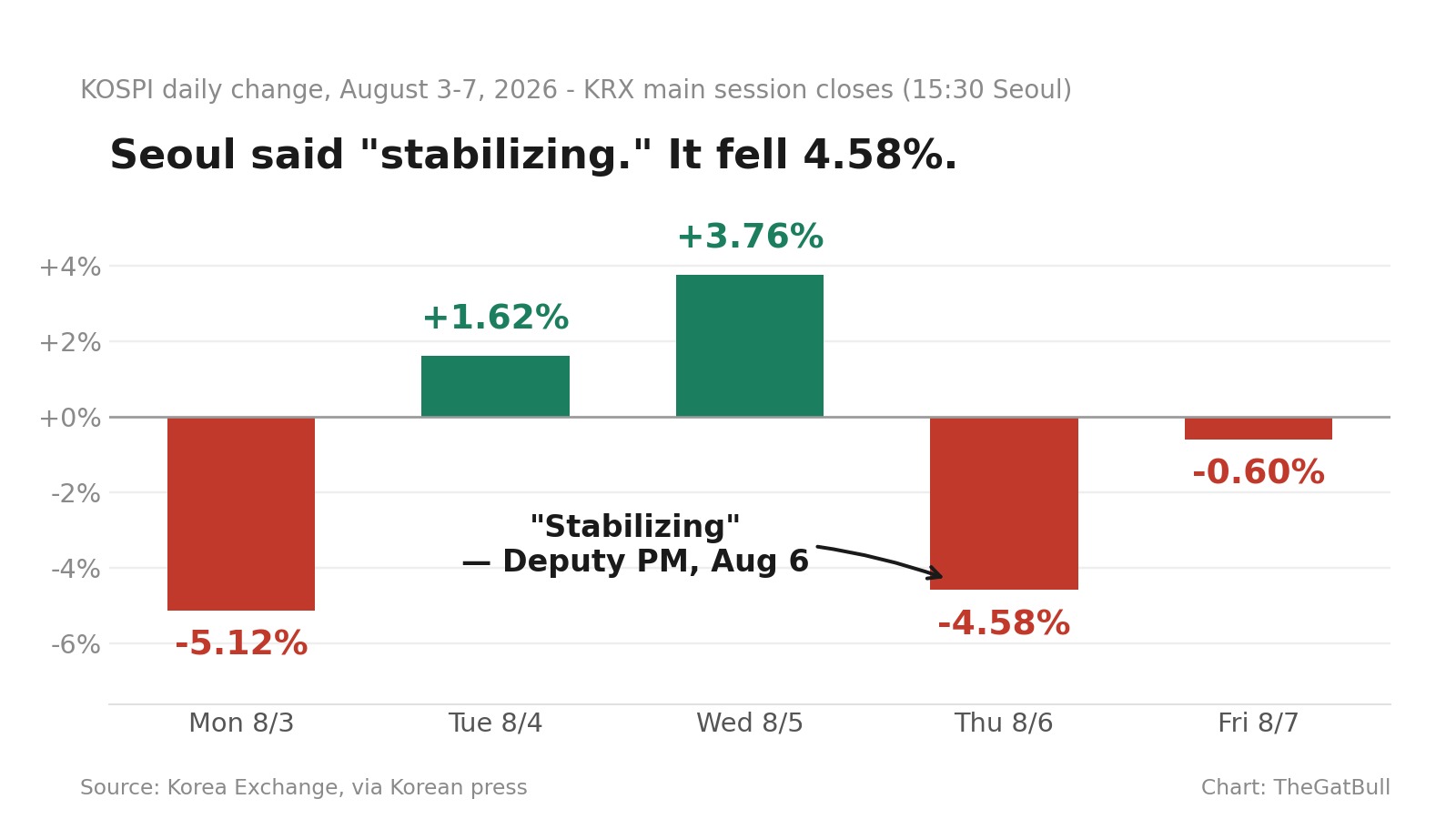
① “A stabilizing trend” — the index fell 4.58% that day
At 9:14 a.m. on August 6, Deputy Prime Minister Koo said the index had “recently been on a stabilizing trend.” The KOSPI closed that day at 6,296.38, down 4.58%, on the Korea Exchange regular session.
This need not be a contradiction. The remark came minutes after the open, and the “stabilization” the government referred to may mean the calming of July’s extreme volatility rather than a single day’s move. In July, sidecars triggered on 14 of 20 trading sessions — the mechanics are laid out in Korea’s three-layer brake system.
What a reader should take away is simply that both sentences existed on the same day. The government’s time axis and the market’s time axis are not the same axis.
② The baselines differ — 2,700 or 9,114
This gap did not appear this week. At his one-year anniversary press conference on June 8, 2026, President Lee said that “you could call it a great crash now that 8,000 has broken, but compared with 2,700 it has risen enormously.” (Note the date — that is a June 8 remark, not a remark from this week.)
- The starting point the government often cites, about 2,700, against the August 7 close of 6,258.77: +132%
- The high the market watches, the record close of 9,114.55 on June 22, against August 7: −31.33%
Both are facts. Looking at the same index, one side sees three years of gains and the other sees seven weeks of losses. Which baseline is correct is not for this site to decide. But the practical advice holds: when reading Korean policy statements, check compared with what every single time.
③ Won weakness outside, won strength inside
Secretary Bessent said yen weakness was dragging the won lower on August 4, US Eastern time, and the situation he was describing was the late-July setup.
Seoul’s won moved the other way in the first week of August.
- August 5: USD/KRW 1,424.5 at the 3:30 p.m. Seoul close
- August 6: 1,423.8 (−0.7)
- August 7: 1,416.1 (−7.7)
Intraday on August 6 the won reached the 1,415 area, a ten-month high for the currency (intraday — not a closing level).
The timing mismatch is the thing to hold onto. The won weakness Washington was worried about and the won strength Seoul actually experienced are looking at different points inside the same week. Line up the dates alone and write “the Treasury Secretary was wrong” and you have written a meaningless sentence. And because the main US vehicle for Korean equities is unhedged, the direction of the won lands in the return whichever way it goes — what that vehicle actually holds is broken down in the EWY concentration piece.
4. What Seoul was answering
There is something unusual in the Deputy Prime Minister’s remark: the target of the answer is named. He spoke “regarding foreign press coverage that raised concerns about investing in the Korean stock market.”
The contents of that coverage are confirmable only within what Korean media relayed. Both originals sit behind paywalls, so they are recorded here with double attribution.
- Financial Times, dated August 3, from Seoul: that Korea has become one of the most volatile markets in the world, and that the losses are becoming a political threat to President Lee — as relayed by Newsis. The same article also carried market participants’ view that the approval of the first single-stock leveraged ETFs in late May amplified volatility.
- Bloomberg: a warning that the Korean market could fall to uninvestable status if it fails to restore investor confidence — as relayed by Electronic Times on August 3. Because the word itself is the substance of the quotation, this article does not quote it directly until the original is checked.
The market implication sits here. A government naming foreign press coverage and answering it is a signal that foreign investor perception has entered the policy priority stack. And the next day, August 7, came the report that the President had ordered the ISA reform bill and the share-price-suppression prevention bill sent back to the drawing board (reported, not an official statement from the presidential office). Whether the two events are causally linked is not confirmed. Only the sequence is recorded.
5. Who stayed silent this week
When there is no statement, we say there is none. With the index 31.33% below its June high, the following made no new remarks about the market this week.
- Financial Services Commission and Financial Supervisory Service — nothing new since the July 28–29 leveraged-product measures, which included raising the base deposit requirement to ₩30m effective July 31. But a tightening of disparity management is scheduled for August 19, so this is a phase that moves by calendar rather than by statement.
- Bank of Korea Governor — no monetary policy remarks; only the June balance of payments release. The next rate meeting is August 27.
- US Treasury — no official document concerning Korea. The won reference came through an interview, not a document.
- Korean FX authorities on whether they intervened — no first-party confirmation this week either.
Silence is information too. The regulators going quiet most likely means July’s rush of statements has moved into the implementation phase.
6. Tokyo’s ledger — zero and a record in the same table
| Disclosed | Period covered | Amount |
|---|---|---|
| July 31 | June 29 – July 29, 2026 (monthly) | ¥0 |
| August 7 | April – June 2026 (daily detail) | April 30: ¥6.2787trn (~$40bn), largest single day on record. With May 4 and May 6, three days totaling ¥11.7349trn (~$74bn) |
Set those two lines side by side and one thing is settled. All through July, the market talked about Japan intervening — and through July 29, on the ledger, all of it was verbal. It was a month held up by words alone.
Then on July 30 and 31 the words became an operation. The confirmed size of that operation — market estimate ¥11–12trn — lands in the monthly disclosure at the end of August. That is the number this column checks next.
Conversion basis: ¥ to $ at ¥158/$ (early August 2026 level); ₩ to $ at ₩1,416.1/$ (Seoul, 3:30 p.m., August 7, 2026).

7. The week in one sentence
What came out of Seoul in the first week of August was not a forecast. It was a rebuttal. The government named foreign coverage and answered it, the President told his own government to look again at rules it had written (reported), and the financial regulators are waiting on an August 19 effective date rather than speaking. Meanwhile Washington called the won by name and Tokyo published a ledger showing July intervention of zero.
None of it was assembled on an English wire. Bloomberg is faster on prices. But nobody carries what the officials said.
Under the Gat. The government’s baseline is 2,700 and the market’s baseline is 9,114. Which one is right is not for this site to decide. But it is better to read them knowing that two people are looking at the same index and quoting different numbers. And in a week when a US Treasury Secretary called the currency inside your EWY by name, it is worth remembering that the sentence was about buying yen — not about buying won. View, not advice.
8. What’s on the calendar
- August 14 (Fri) — statutory deadline for semiannual reports; last session before a three-day break (August 15 Liberation Day falls on Saturday; Monday August 17 is a substitute holiday and the market is closed)
- August 19 (Wed) — tightened disparity management for single-stock leveraged products takes effect; watch whether the FSC’s flagged “additional measures” are triggered
- August 27 (Thu) — Bank of Korea rate decision, the first since July’s unanimous hike from 2.50% to 2.75%
- End of August — Japan’s Ministry of Finance monthly intervention disclosure covering July 30 to August 27, which will confirm the size of the coordinated operation
- September — US FOMC; after the weak August 7 US employment print, a hold is the prevailing expectation (media observation)
- Typically October — US Treasury exchange-rate report; whether Korea appears on the monitoring list, and how the won is described
Not financial advice. This is a record of what public officials said, not a recommendation. Investing in the Korean market carries currency, liquidity and regulatory-change risk.
Frequently Asked Questions
Did the United States intervene to defend the Korean won?
No. What the United States and Japan bought on July 30 and 31 was yen, confirmed in a joint announcement by both governments on August 3. US Treasury Secretary Scott Bessent cited yen weakness spilling into won weakness as one reason for that intervention, in an August 4 interview (US Eastern time). The won was named as a reason, not as a target. There is no first-party confirmation of intervention in the won itself. Not financial advice.
Did the Korean government intervene in its own stock market?
There is no first-party confirmation this week. Korean authorities typically say they are “closely coordinating” without confirming any operation. “Coordinating” and “bought” are different statements, and this site records them separately.
Who actually used the word uninvestable?
Korean media reported that the word appeared in Bloomberg coverage warning that the Korean market could become uninvestable if investor confidence is not restored. The original is behind a paywall, so this article does not quote it directly. It will be updated if the original is verified.
Did the KOSPI really fall 4.58% on the day an official said it was stabilizing?
Yes. Deputy Prime Minister Koo Yun-cheol spoke at 9:14 a.m. on August 6. The KOSPI closed that day at 6,296.38, down 4.58%, on the Korea Exchange regular session ending at 3:30 p.m. Whether the government meant the single day or the calmer trend after July’s extreme volatility cannot be settled from the statement alone.
If I hold EWY, which of this week’s statements matters?
Two things. First, currency — EWY is unhedged, so the won’s direction flows straight into your return, and a US Treasury Secretary publicly framing Asian currency stability as a policy concern changes the character of that variable. Second, rules — the August 19 tightening of single-stock leveraged ETF disparity management, and the reopening of the ISA reform bill, both touch the volatility structure of the Korean market. Not financial advice.
This article is for informational purposes only and is not financial advice. TheGatBull may earn a commission from some links at no cost to you — see our disclosure and full disclaimer.