Not financial advice. This article is informational and is not a recommendation to buy or sell any security.
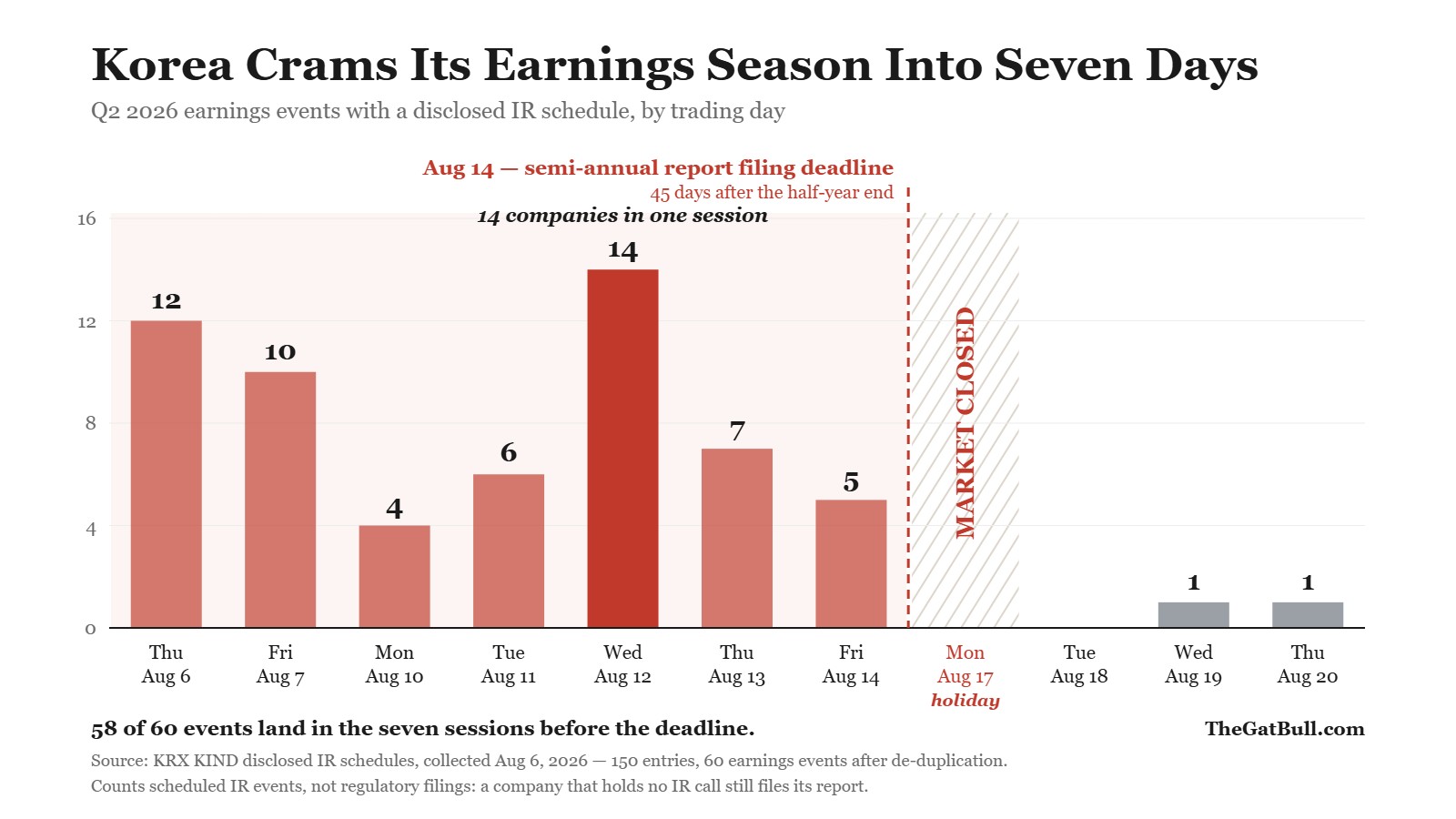
Korean second-quarter earnings started this week. Sixty companies have filed an investor-relations schedule with the Korea Exchange — and 58 of them, 97%, land between August 6 and August 14. Not spread over six weeks the way a US reporting season is. Seven trading days.
The reason has nothing to do with results. It is a filing deadline: Korean companies must submit their semi-annual report within 45 days of the half-year end, which this year falls on Friday, August 14.
The calendar
| Date | Events | Names you may recognise |
|---|---|---|
| Thu, Aug 6 | 12 | Kakao · Korea Zinc · LG Uplus · KT&G · CJ ENM |
| Fri, Aug 7 | 10 | NAVER · Lotte Chemical · Lotte Shopping · CJ CGV |
| Mon, Aug 10 | 4 | KEPCO KPS · Korea District Heating · SK bioscience |
| Tue, Aug 11 | 6 | GS · CJ CheilJedang · CJ Logistics · NCSOFT · NHN |
| Wed, Aug 12 | 14 — the peak | Hanwha Life · Meritz Financial · Mirae Asset Securities · JYP |
| Thu, Aug 13 | 7 | Samsung Life · Samsung Fire & Marine · DB Insurance · LG Corp |
| Fri, Aug 14 | 5 — deadline | Hyundai Marine & Fire · SK Networks · Mirae Asset Life |
After that the season is effectively over: one event on August 19, one on August 20. Source: Korea Exchange KIND disclosed IR schedules, collected August 6, 2026.
Under the Gat. On a US calendar, earnings season is a set of dates companies choose. On a Korean one, it is the week in front of a legal deadline. Miss that single sentence and you miss the whole second week of August, every year.
Four things the calendar tells you
1. The deadline builds the calendar — and it sits before a long weekend
Forty-five days after the half-year end is August 14. The US has filing deadlines too, but American companies typically report well ahead of theirs and spread out across roughly six weeks. Korean companies bunch up against the date. That is how you get 14 companies reporting in a single session on August 12.
This year the compression is a little tighter than usual. Liberation Day, August 15, falls on a Saturday, so Monday August 17 is a substitute holiday and the market is closed. The filing deadline is therefore the last trading day before a three-day weekend. (August 18 is a normal session — it is empty on the calendar simply because nobody scheduled anything.)
2. The big two already went
Samsung Electronics and SK Hynix are not on this list. They reported in July — SK Hynix on July 29. Korea runs a two-tier season: the giants that dominate the index go early and alone, then everyone else crowds into the deadline week. If you think of “Korean earnings season” as one block, you miss the split. How the sequencing works, and what a Korean earnings release actually contains, is taken apart in how Korean earnings season actually works. For the SK Hynix schedule specifically, the standing page is the SK Hynix Investor Hub.
3. This table is not the whole market
An important limit on the data. KIND lists investor-relations events that companies choose to disclose — conference calls and presentations. That is not the same thing as the regulatory filing. A company that holds no IR call still files its semi-annual report. So read 60 as “companies that scheduled an event,” not “companies reporting results.” The real filing count is larger and lands by the same August 14 date.
4. KEPCO is missing — and its subsidiary is not
Korea Electric Power (KRX: 015760 / NYSE: KEP) does not appear anywhere in the 150 KIND entries. Its subsidiary KEPCO KPS is on the calendar for August 10, and so is fellow state-owned utility Korea District Heating. KEPCO’s own IR calendar has no second-quarter entry either; that page was last updated on May 11, and for the first quarter the date was posted two days before the release.
So: the subsidiary has a date and the parent does not. Some market chatter pointed to August 7 for KEPCO’s second-quarter results. Neither primary source supports it. Last year the company reported its second quarter on August 14 — the deadline itself. We have written about KEPCO’s regulated-utility economics before, in the KEPCO versus Southern Company comparison, and we will cover this quarter once a date is actually announced.

The one-line takeaway
Korean earnings season is not defined by when it starts. It is defined by when the law says it has to be finished. August 14 is the deadline, and the seven sessions in front of it are the season. If the index moves on August 12, do not read it as one company’s news — fourteen of them are putting numbers on the table that day.
FAQ
When do Korean companies report second-quarter earnings?
Mostly between August 6 and August 14, 2026. Of the 60 companies that disclosed an investor-relations schedule to the Korea Exchange, 58 fall in those seven trading days. The busiest day is Wednesday, August 12, with 14.
Why do so many Korean companies report in the same week?
The semi-annual report must be filed within 45 days of the half-year end, which puts the deadline on August 14, 2026. Rather than spreading out well ahead of the deadline as US companies typically do, Korean companies cluster against it.
What about Samsung Electronics and SK Hynix?
Both reported in July — SK Hynix on July 29 — so neither appears on the August calendar. Korea effectively runs a two-tier season, with the largest index constituents going first.
When does KEPCO report its second-quarter results?
It has not been announced as of August 6, 2026. KEPCO does not appear in the Korea Exchange IR schedule, and its own IR calendar has no second-quarter entry. Its subsidiary KEPCO KPS is scheduled for August 10. Last year KEPCO reported its second quarter on August 14.
Does this list cover every company reporting?
No. It counts investor-relations events that companies disclosed to the exchange. A company that holds no IR call still files its semi-annual report by the same deadline, so the number of filings is larger than the number of scheduled events.
Sources
- Korea Exchange KIND — disclosed IR schedules (primary), all 150 entries collected August 6, 2026: kind.krx.co.kr
- Korea Electric Power — official IR calendar (primary): kepco.co.kr
- Yahoo Finance — KOSPI and constituent closes (KRW, KRX, Asia/Seoul)
Not financial advice. TheGatBull does not recommend buying or selling any security. The calendar reflects schedules disclosed as of August 6, 2026 and companies may change their dates. Investment decisions and their consequences are your own.