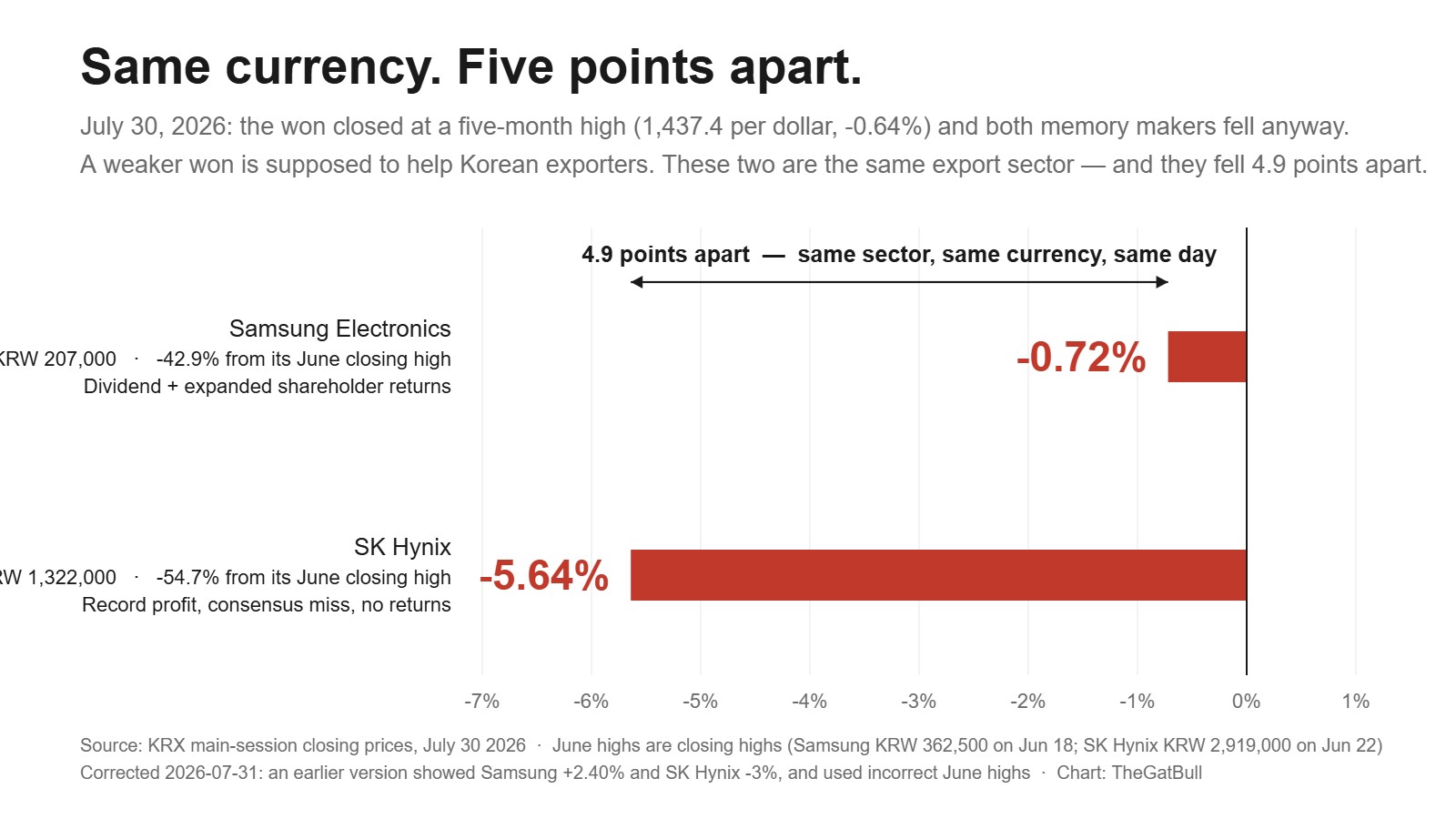
Correction — July 31, 2026. An earlier version of this article reported Samsung Electronics closing at ₩213,500 (up 2.4%) and SK Hynix at ₩1,359,000 (down about 3%) on July 30. Both figures were wrong, and Samsung’s direction was wrong — it fell that day, it did not rise. The correct closes are Samsung ₩207,000 (−0.72%) and SK Hynix ₩1,322,000 (−5.64%), confirmed against exchange data and independently by SK Hynix’s July 31 limit-up arithmetic. The error came from a price source we did not cross-check. The chart and every affected passage have been rebuilt. The argument here never rested on one stock rising and the other falling — it rests on the gap between two companies in the same sector under the same currency. With the corrected figures that gap is 4.9 points, wider than what we originally published. Updated again the same evening: the June peak levels used for the “from the June high” column were also wrong. Verified against exchange price history, the June closing highs were ₩362,500 for Samsung (June 18) and ₩2,919,000 for SK Hynix (June 22), which puts the July 30 closes 42.9% and 54.7% below them. All figures on this site are now stated on a single basis: the KRX main-session close.
On Thursday, July 30, two prices in Seoul moved in opposite directions. The won closed at 1,437.4 per dollar, down 9.3 won (0.64%) — its firmest level since February 26 — and a falling exchange rate means the won got stronger. The same day the KOSPI fell 69.68 points, or 1.23%, to 5,593.56, a third straight decline. (All closing values.)
Seen from a U.S. account, that pairing looks out of order. The familiar script reads: when an emerging market sells off, its currency sells off too. And a cheaper currency is good news for exporters. Korea tested both sentences this week. Stocks fell, the currency strengthened, and exporters did not celebrate.
So here is the claim worth examining: “a weaker won helps Korean exporters.” It is half true. The true half lives in the accounting. The false half lives in the direction of causation.
🎩 Under the Gat — Saying the exchange rate helps exporters isn’t wrong; it’s low-ranked. Today the won applied identically to every listed company in Korea. Shipbuilders and defense names rose. One memory maker rose and the other fell. A variable that is the same for everyone cannot explain outcomes that differ.
Where the belief holds — translated profit really does rise
Let’s build the case for it honestly first. Large Korean manufacturers collect much of their revenue in dollars and pay a meaningful share of their costs in won — domestic labor, some components, depreciation on local plant. When the won weakens, the same dollar revenue converts into more won, and that difference shows up below the operating line. It’s why “FX effect” gets its own line in quarterly results.
American investors know this logic because of Japan. A decade of buying automakers and machinery names whenever the yen slipped, packaged into currency-hedged Japan ETFs, made the trade familiar. The formula is real.
Not a perfect parallel — and this is where Korea diverges.
First break — half of Korea’s index is priced in dollars
For the Japanese formula to work, you need a thick layer of dollar revenue against home-currency costs. Memory semiconductors, which carry an enormous share of the KOSPI’s market value, don’t sit that way.
- Selling prices are set in dollars. DRAM and HBM prices come from international contract and spot markets. These are not goods that fetch more because the won weakened.
- A large share of costs is also in dollars. Lithography and etch equipment is imported; many materials settle in dollars. A weaker won makes this line more expensive.
- Energy is entirely imported. Korea is a net energy importer, so won weakness lands directly on the power and fuel bills that run a fab.
In memory, the exchange rate pushes revenue and cost at the same time, so the offsetting range is wide. And something far larger sits on top of it — the price cycle and the competitive map. What shook Korean chips this week was not the won; it was a repricing of Chinese memory competition, and that would have happened whichever way the currency went.
If you hold a Korea ETF, the reason this structure lands directly in your account is easiest to see in what’s actually inside EWY — in an index where two names fill close to half the fund, “Korean exporters” effectively means “two memory stocks.”
Second break — why the won actually strengthened today
This is what made the session unusual. Read the list of reasons the won gained, and the arrow of the conventional wisdom points backwards.
Currency dealers quoted in Korean coverage cited: dollar inflows tied to SK Hynix’s Nasdaq-listed ADRs (American Depositary Receipts — certificates that let a foreign stock trade on a U.S. exchange), dollar proceeds from shipbuilding orders at Hanwha Ocean and other yards, and month-end selling of dollars by exporters. Added to that, the dollar softened after the Federal Reserve held its policy rate at 3.50–3.75% at the July meeting.
Now reverse the reading order. Korea sold ships, chips and equity, earned dollars, and the act of converting those dollars into won is what made the won stronger. On that path the exchange rate is not an input to export competitiveness. It is an output of export performance.
🎩 Under the Gat — The conventional wisdom says “the won has to get cheaper for us to sell well.” Today the Seoul FX market said “we sold well, so the won got more expensive.” Both relationships exist, but mixing up the direction inverts the investment conclusion. Before buying an exporter because of the exchange rate, check whether that rate is currently sitting in the cause seat or the result seat.
Third break — same currency, same sector, five points apart
The cleanest refutation is the two memory makers. The won applied to both identically. Their closes still landed 4.9 points apart.
| July 30 close | Move | From the June high |
|---|---|---|
| Samsung Electronics — ₩207,000 | −0.72% | −42.9% (₩362,500, Jun 18) |
| SK Hynix — ₩1,322,000 | −5.64% | −54.7% (₩2,919,000, Jun 22) |
Both are Korean memory. Both sell goods priced in dollars. Both met the same won. One rose and one fell.
The reason sat outside the exchange rate. Samsung announced a second-quarter dividend of ₩374 per share and an expanded shareholder-return plan, and told its earnings call it expects the memory shortage to run into 2028. SK Hynix, one day earlier, posted the best quarter in its history, missed consensus by 4.7%, and released no shareholder-return package alongside it.
Two companies in the same industry gave different answers within a day of each other, and the market priced the difference. The currency did not get a vote.
What SK Hynix’s session actually told the market — record profit, a 24-point intraday swing, and no returns — is broken down here.
Shipbuilders, defense and financials also traded higher (sector moves are intraday readings). Shipbuilding’s divergence runs on an order book, not an exchange rate — the reason Korean yards trade on their own track is in this piece on U.S. Navy work. Defense had its own catalyst in renewed Middle East conflict. Financials were about earnings and payouts.
If one exchange rate can’t explain three divergent groups — and can’t even explain two companies in the same industry — it wasn’t the day’s governing variable.
What the flows left behind
Underneath a third straight decline, hands changed. On the KOSPI, foreigners bought a net ₩1.33 trillion (about $927M), turning buyers for the first time in five sessions, and institutions were net buyers in the trillion-won range. Retail investors sold a net ₩1.42 trillion (about $988M) — the side that had been holding the index up moved to the sell side.
That picture doesn’t fit the sentence “foreigners left Korea, so the won collapsed.” Today foreigners were net buyers and the won strengthened. Though declaring a trend from one session of flows is exactly the error this article is arguing against.
How to actually handle this currency exposure inside a Korea position is a separate problem, and Korea is a market where the hedged-ETF option effectively no longer exists — the toolkit is laid out here.
The verdict
“A weaker won helps Korean exporters” — partly true, but low-ranked.
- The translation effect on profit is real ✓
- But memory, which carries the index, has dollars on both the revenue and cost side, so the offsetting range is wide ✗
- And the exchange rate also moves as a result of export performance, so fixing the direction of causation leads you to misread it ✗
- Decisively, under the same currency, two companies in the same industry closed 4.9 points apart ✗
What an investor should watch is not the direction of the exchange rate but which line of which ledger it enters. The same won strength lands as cost relief for refiners, airlines and utilities; as close to neutral for memory; and as a secondary variable against the order book for shipbuilders. In one line — the exchange rate tells you the nationality of the ledger, not the direction of the index.
🎩 Under the Gat — To repeat: this is absolutely not an argument for flipping to the opposite formula (“a stronger won means stocks go up”). One day of data is one day of data. The use of this piece is subtraction, not prediction — take the exchange rate out of the number-one slot when you look at Korean exporters, and put product prices and the competitive map there instead. That reordering still holds next quarter. A view, not advice.
This is a view, not investment advice. Figures are July 30, 2026 closing values (FX basis ₩1,437.4 per dollar, 3:30 p.m. Seoul close); intraday readings are labelled as such. Closing prices and percentage moves were verified against exchange price history on July 31, 2026 and reflect the KRX main session. Sector-level moves and some flow figures remain subject to KRX final tallies.
FAQ
Stocks fell hard — why didn’t the won fall with them?
On July 30 the won closed 9.3 won stronger at 1,437.4 per dollar (3:30 p.m. Seoul close). Market participants pointed to dollar inflows tied to SK Hynix’s ADR listing, proceeds from shipbuilding and heavy-industry orders, month-end exporter dollar selling, and a softer dollar after the Fed’s July hold. Equity selling and currency selling do not always arrive together.
Does a weaker won help Korean exporters?
In accounting terms, translated profit rises. But memory semiconductors — which carry the weight of the Korean index — have both selling prices and major costs denominated in dollars, so the effect offsets across a wide range, and Korea’s fully imported energy adds cost pressure on the same move. The memory price cycle and the competitive map move these stocks far more than the exchange rate does.
Why did Samsung Electronics and SK Hynix fall by such different amounts on the same day?
Both met the same won strength, but the closes split — Samsung ₩207,000 (−0.72%), SK Hynix ₩1,322,000 (−5.64%). Samsung announced a ₩374 second-quarter dividend and an expanded shareholder-return plan; SK Hynix had posted record profit a day earlier while missing consensus and offering no return package. Shareholder returns, not the currency, set the size of the drop.
Can the Japanese “weak currency = buy exporters” formula be applied to Korea?
The structures differ. Japanese exporters carry a thicker mix of home-currency costs against dollar revenue, while Korea’s index leadership is concentrated in memory, which is priced in dollars. It is not a clean parallel.
What were the July 30 closes for the KOSPI and KOSDAQ?
KOSPI 5,593.56 (−1.23%) and KOSDAQ 644.78 (−2.70%). The KOSPI traded as high as 5,976.82 before giving the gain back (that high is an intraday figure).
What did the flows look like?
On the KOSPI, foreigners bought a net ₩1.33 trillion — their first buying session in five — institutions were net buyers in the trillion-won range, and retail investors sold a net ₩1.42 trillion.