On July 31, South Korea’s government announced a plan to create what it is calling a “Korean-style strategic sovereign wealth fund.” Initial capital: ₩20 trillion plus, or roughly $14 billion. It will sit inside the Korea Investment Corporation (KIC) as a new Strategic Investment Account, and it is meant to make long-horizon investments in three areas — semiconductors, AI data centers, and physical AI. It starts operating in 2027.
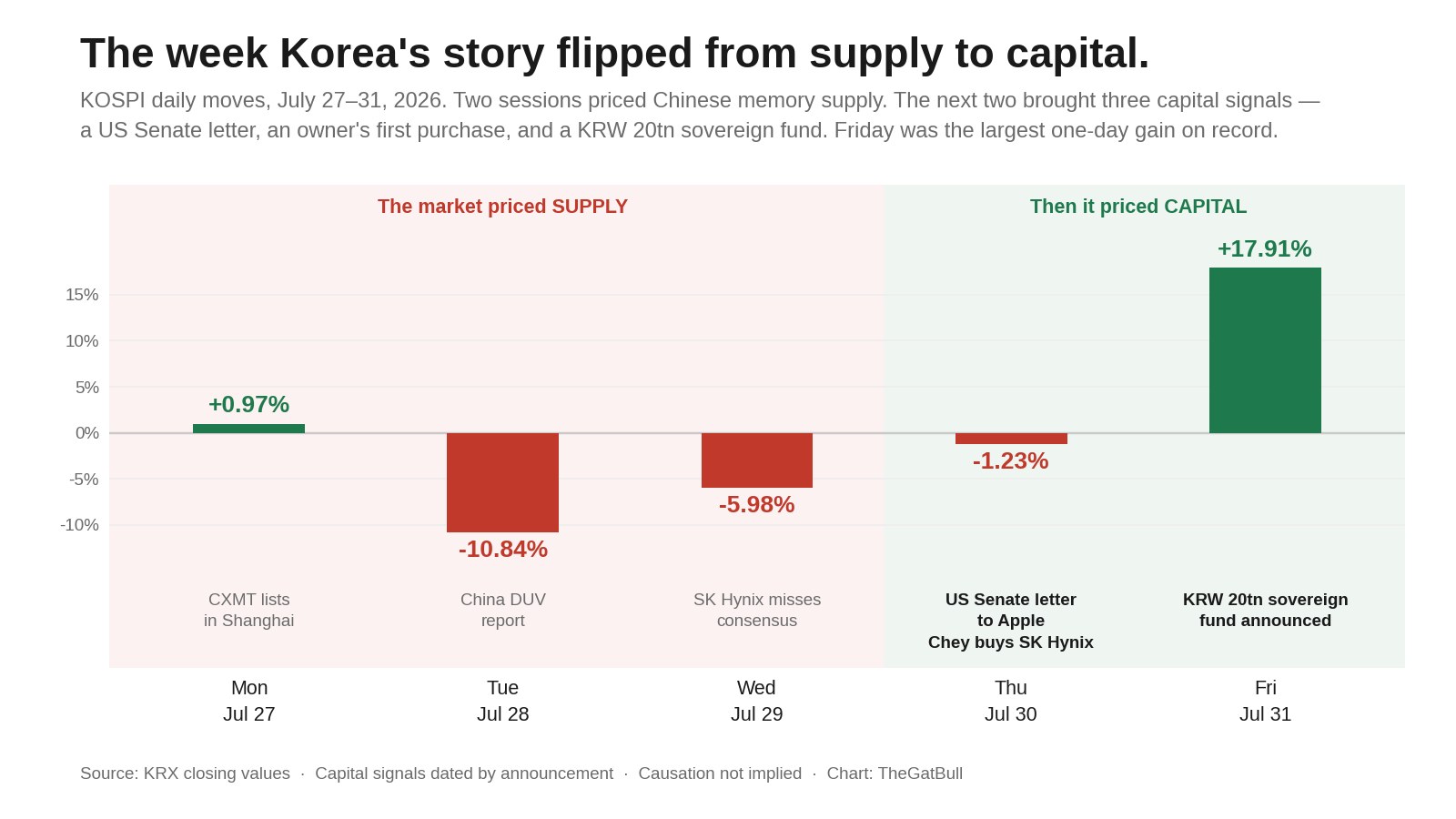
The same day, the KOSPI closed up 1,001.89 points, or 17.91%, at 6,595.45. That is the largest one-day gain in the index’s history, in both percentage and points. The previous percentage record was 11.95%, set on October 30, 2008.
Two things happening on the same day is not the same as one causing the other. Friday’s session also had short covering, the exhaustion of forced margin selling, and bargain hunting in it, and nobody has separated out how much of the move belonged to each. So set causation aside. The more useful thing to read is the blueprint of the announcement itself.
And the blueprint contains something the headline missed.
▶ What this means for global investors
① This is not news about size. It is news about direction — Korea’s sovereign wealth fund has invested only abroad for twenty years, and for the first time it is being pointed inward.
② The ₩20 trillion is not money to buy with. It is money to call with. The government used the word “anchor” itself, and the intended audience for that word is foreign sovereign funds and global asset managers.
(Won figures are converted at USD/KRW 1,424.0, the July 31, 2026 Seoul close at 3:30 p.m. The won strengthened for a fourth consecutive session. This article is one person’s view, not advice.)
The sovereign wealth funds American readers already know
Say “sovereign wealth fund” to a US investor and roughly three things come to mind.
Norway’s Government Pension Fund Global (NBIM) — North Sea oil money parked in stocks and bonds across the planet, the largest single investor on Earth. Singapore’s GIC and Temasek — a city-state’s reserves and state-owned assets run as a global portfolio. Saudi Arabia’s PIF — oil revenue being converted into sports, gaming, and electric vehicles.
All three share one grammar: they are vessels for sending domestic surplus abroad. Oil or trade surplus, money the country cannot spend at home gets planted outside and held for future generations.
Korea has an institution in that lineage. It is the Korea Investment Corporation, which made its first investment in 2006 with $1 billion and managed $206.5 billion as of end-2024. It is one of the world’s larger sovereign funds, and the reason its name is unfamiliar to American readers is simple — it has invested quietly, and only overseas.
That is precisely what changes here.
The bridge — what is actually new
The sentence that matters more than the ₩20 trillion is this one: the Strategic Investment Account may invest domestically.
KIC has run foreign assets since it was founded. Bloomberg described this move as expanding its mandate to include domestic assets for the first time. Twenty years of pipe that ran only outward is getting a valve that opens inward.
So this is not an extension of the Norway/GIC/PIF lineage. It runs the other way.
Not a perfect parallel — and the funding sources make the difference sharper still.
- ₩16 trillion from state policy banks — the Korea Development Bank, the Export-Import Bank of Korea, and the Industrial Bank of Korea
- About ₩4 trillion in “in-kind” shares — equity the government already holds because heirs paid inheritance and gift tax in stock rather than cash
Not oil. Not a trade surplus. This is not newly earned money; it is a reallocation of assets the state already owned. The name says sovereign wealth fund. The function is closer to an industrial policy instrument.
The moment Korea claimed the AI supply chain as a national project has already happened — it was in San Francisco on July 24. I laid out what was declared and why here. Friday’s announcement reads most accurately as the money arriving behind that declaration.
🎩 Under the Gat — Don’t let the word fool you. “Sovereign wealth fund” normally means planting a nation’s surplus abroad. This one means turning state-held assets back inward. Same label, opposite job. And for Korea right now, the opposite job makes more sense — what Korea lacks is not foreign exposure. It is long-duration capital willing to fund domestic AI infrastructure.
Our yard — ₩20 trillion is not money to buy with
Put the number in its place first. ₩20 trillion is about $14 billion.
That is roughly 7% of the $206.5 billion KIC already runs, and it is an order of magnitude away from Norway’s fund. It is far smaller than the phrase “sovereign wealth fund” suggests.
But the government never said it would use this money to buy the market. It said it would be an anchor.
The logic runs like this — the three mega-projects (semiconductors, AI data centers, physical AI) have raised foreign interest in Korean advanced industry, but there was no domestic anchor investor to go in alongside. Lee Hyoung-il, First Vice Minister of Economy and Finance, put it as an arrangement where foreign sovereign funds “can come and play the anchor role together,” which also helps get the thing built quickly.
Translated: the real recipient of this announcement is not the Korean retail investor. It is the allocator in Abu Dhabi, Singapore, and New York. The ₩20 trillion exists to show them that Korea is putting its own money in too.
Private capital is already on this stage. Nvidia taking a 4.5% stake in Naver and climbing onto the AI factory build was a structure I took apart through the filing in this piece. What is different now is that the buyer is the state, not a company.
Three capital signals arrived in the same week
Taken alone, the sovereign fund announcement is hard to size. But this week delivered three answers to the same question, back to back. The question: who is putting money and protection behind this industry?
| Date | Signal | Actor |
|---|---|---|
| Jul 30 | Seven US senators press Apple to publicly commit to avoiding Chinese memory (Aug 21 deadline) | US Congress |
| Jul 30 | Chey Tae-won buys SK Hynix shares for the first time — ₩4.786 billion | The owner |
| Jul 31 | ₩20 trillion+ strategic sovereign fund announced | Korean government |
One — the owner bought just under the regulatory line
On July 30, SK Group Chairman Chey Tae-won bought 3,620 common shares of SK Hynix on the open market for ₩4,785,640,000. It is the first time his name has appeared on the SK Hynix shareholder register in a personal capacity.
The amount is the interesting part. Korea’s Capital Markets Act requires executives and major shareholders to disclose a trading plan 30 days in advance if the purchase is ₩5 billion or more. ₩4,785,640,000 sits just beneath that threshold.
There is one way to read that. He did not want to wait 30 days. He chose to buy now, without telegraphing it. The size itself does nothing to a company of this market capitalization — the signal is not in the amount. It is in the choice of timing.
Two — the US Congress pushed Chinese memory out from the demand side
The story that broke the Korean market this week was “China is coming.” CXMT’s Shanghai listing on July 27 and a July 28 report that China had developed its own DUV lithography equipment were the triggers.
Then on July 30, seven US senators wrote to Apple on a bipartisan basis — Republican Jim Banks alongside Democrats including Senate leader Chuck Schumer. The demand: publicly commit to not using memory from CXMT and YMTC. The deadline for a response is August 21. The Pentagon has formally designated both companies as Chinese military companies.
There was a movement in the opposite direction behind this. Tim Cook and other Apple executives had been lobbying the Trump administration — Commerce Secretary Howard Lutnick and Treasury Secretary Scott Bessent — for approval to use Chinese memory in products sold outside the United States. The Senate letter is a brake on that effort.
To be precise — this is not a formal US government denial. Buying CXMT chips does not legally require US government approval; only YMTC sits on the Commerce Department’s Entity List and requires an export license. This is the congressional pressure stage, and the administration has not ruled.
The direction is clear regardless. The question is no longer whether Chinese memory is competitive. It is whether the largest customer will be politically permitted to buy it. A narrowing technology gap does not move the supply curve if the route to market is closed.
🎩 Under the Gat — Rebuild the week. Monday and Tuesday, the market priced “China expands memory supply.” Thursday, the US Congress moved to stop the largest buyer from buying it; the same day, the owner bought stock for the first time, just under the disclosure line; Friday, the government added ₩20 trillion. All three are about demand and capital, not supply. What the market sold on Monday and Tuesday and what it bought on Thursday and Friday were operating on different layers.
The day the Chinese memory narrative overwhelmed even SK Hynix’s record quarterly profit is recorded here. The contrast between that day and the back half of this week is the backdrop for everything above.
So what should you watch — five verifiable checkpoints
Instead of qualitative hope, here are items you can actually check.
① Does the law pass? An amendment to the Korea Investment Corporation Act is to be introduced in August, and passage through the National Assembly within the year is the premise. Until it passes, this fund is a plan. Operations begin in 2027.
② Does the anchor actually anchor? The metric is not how much of the ₩20 trillion gets deployed. It is the multiple of foreign money that follows it in. Put in ₩1 trillion and draw ₩3 trillion and it worked. Spend all ₩20 trillion with nobody joining and it was government spending.
③ How is the objective conflict handled? KIC was built to chase financial returns. Layer an industrial policy mandate on top and there will be a moment when returns and policy goals collide. Korean commentators have already flagged concerns about expertise and independence. The governance design will tell you which way it leans.
④ What does Apple say on August 21? That is the Senate’s deadline. If Apple publicly commits to dropping Chinese memory, CXMT and YMTC lose their largest potential customer. If it refuses or stays silent, the decision moves to the administration. This is the next fork in the narrative that broke the Korean market this week.
⑤ What kind of domestic assets does it buy? Listed equities, unlisted or project equity, or physical infrastructure like data centers — the transmission path into the market is completely different in each case. Listed buying lands on the index; project equity lands on supply-chain companies.
If you want to know whether policy has actually moved this market before, the Value-up program copied Japan’s reform and still watched foreigners sell — that record is worth comparing here. The distance between an announcement and an inflow has been a recurring problem in Korea.
🎩 Under the Gat — The temptation to tie Friday’s 17.91% directly to this announcement is strong. Resist it. Record days always have several forces stacked on top of each other, and there is no method for isolating the policy component within a single session. Whether this announcement was real gets settled by the size of the foreign money that arrives in 2027. Until then it is a well-designed invitation, not a signed contract.
The summary
Korea is putting ₩20 trillion of sovereign fund money into AI. That is true. But three things need to be held together.
- The size is smaller than the headline — about 7% of KIC’s existing assets
- The direction is the reverse of a normal sovereign wealth fund — it brings capital home rather than sending surplus out. KIC’s first domestic mandate in twenty years
- The purpose is attraction, not acquisition — the government called itself an anchor
Which means the value of this news is not the ₩20 trillion. It is the money that comes after it. And whether that money comes is a 2027 question.

One thing to add — the signal that arrived this week was not one signal. The government moved ₩20 trillion, the owner moved just under the disclosure line, and the US Congress moved on Chinese memory’s route to market. Three layers pushed in the same direction inside three days, and on the next trading day the index posted its largest gain on record. Causation cannot be asserted. What overlapped is worth writing down.
This article is a personal view provided for informational purposes and is not investment advice or a solicitation to trade (not financial advice). Policy figures are as announced by the Korean government on July 31, 2026 and are subject to change depending on the outcome of the legislative amendment. FX basis: USD/KRW 1,424.0, Seoul market close 3:30 p.m., July 31, 2026. Index figures are KRX closing values. Responsibility for investment decisions and their outcomes rests with the investor.
FAQ
Does South Korea have a sovereign wealth fund?
Yes. The Korea Investment Corporation (KIC) has operated since 2006 and managed $206.5 billion as of end-2024. Until now, however, it has invested only in overseas assets.
What is the new “Strategic Investment Account”?
A new account inside KIC with initial capital of ₩20 trillion plus (about $14 billion). It permits domestic investment for the first time in KIC’s history, and will make long-term investments in three mega-projects — semiconductors, AI data centers, and physical AI — plus strategic sectors including materials/components/equipment, nuclear power, aerospace, and quantum.
Where does the money come from?
₩16 trillion in contributions from state policy banks (Korea Development Bank, Export-Import Bank of Korea, Industrial Bank of Korea), plus about ₩4 trillion in shares the government holds because inheritance and gift taxes were paid in stock rather than cash. This is a reallocation of existing assets, not new revenue like oil or a trade surplus.
When does investing begin?
2027. An amendment to the Korea Investment Corporation Act is to be introduced in August 2026 with passage targeted within the year, followed by enforcement decree revisions. Until the law changes, this is a plan.
What does it mean for foreign investors?
The stated design purpose is to become a domestic anchor investor that attracts co-investment from foreign sovereign funds and global asset managers. So the size of the money that follows matters more than the ₩20 trillion itself.
Chey Tae-won bought SK Hynix shares — why ₩4.79 billion?
On July 30, 2026 he bought 3,620 common shares for ₩4,785,640,000 on the open market, his first purchase in a personal capacity. Under Korea’s Capital Markets Act, insiders must disclose a trading plan 30 days in advance for purchases of ₩5 billion or more. The amount was set just below that threshold — which reads as a choice to buy immediately rather than wait 30 days.
Did the US ban Apple from using Chinese memory?
Not yet, and it is not a ban. On July 30, 2026, seven US senators wrote to Apple on a bipartisan basis demanding a public commitment not to use CXMT or YMTC memory, with a response deadline of August 21. Legally, buying CXMT chips does not require US government approval; only YMTC is on the Commerce Department’s Entity List and requires an export license. This is the congressional pressure stage and the administration has not ruled. The background is that Apple executives had been asking the administration for permission to use Chinese memory in products sold outside the US.
Was the July 31 KOSPI surge caused by this announcement?
The KOSPI rose 17.91% (1,001.89 points) that day to close at 6,595.45, the largest one-day gain on record in both percentage and points. But short covering, the exhaustion of forced margin selling, and bargain buying were all in play, so it cannot be attributed to the policy announcement alone.