This article is for informational purposes only and is not financial advice. TheGatBull may earn a commission from some links at no cost to you — see our disclosure and full disclaimer.
This is not financial advice — a view from Seoul, not a recommendation to buy or sell anything. (Dates and Korean market figures are on Seoul time: closes are the 3:30 p.m. KST regular-session close on the Korea Exchange. Figures for US-listed instruments — ADRs, ETFs, US shares — are labeled by US trading day, which ends hours after Seoul’s. Won-to-dollar conversions use each date’s 3:30 p.m. Seoul close: ₩1,432.5/$ on August 4, ₩1,424.0/$ on July 31, ₩1,437.4/$ on July 30. Aggregate and USD-sourced figures are converted at the August 4 rate.)
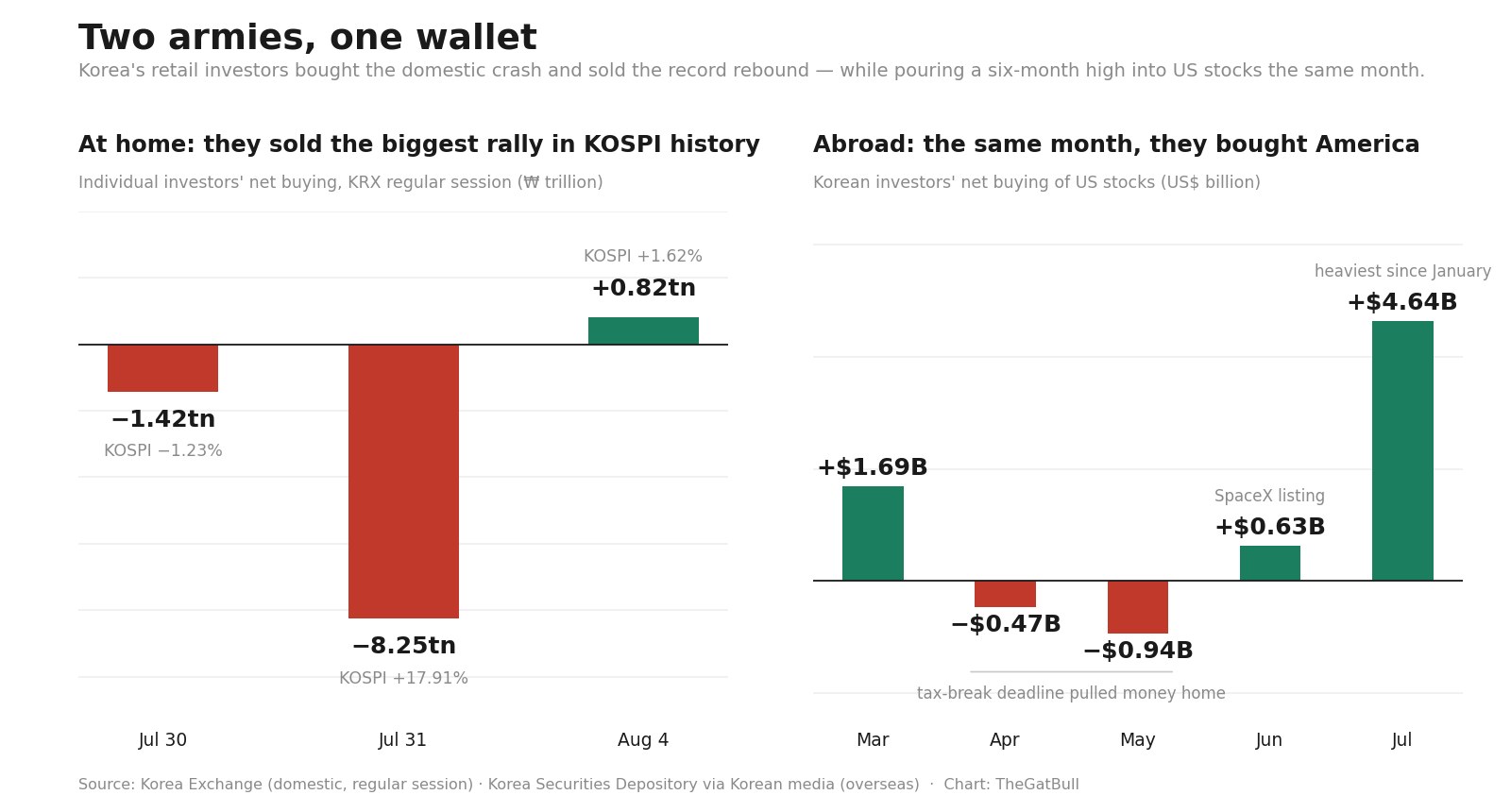
The one-paragraph answer. Treat Korean retail investors as one crowd and July 2026 makes no sense. They are not one crowd — they have two names. Buy Korean stocks and you are a donghak gaemi (donghak ant); buy American stocks and you are a seohak gaemi (seohak ant). In July, both armies moved at once, in opposite directions. At home, individuals absorbed the selling through the worst monthly drop in modern KOSPI history (−22.19%), then posted a record single day of net selling — ₩8.25 trillion (~$5.80B) on July 31, the day the index rose 17.91%, its largest gain ever. Abroad, the same investor base bought roughly $4.64B (~₩6.65tn) of US stocks, the heaviest month since January, per Korea Securities Depository data cited by Korean media. Their No. 1 buy was a 3x leveraged semiconductor ETF. Their No. 2 was SK Hynix’s Nasdaq ADR — bought in the very month they set a record dumping that company’s Seoul shares. This piece explains where the two names come from, what each army did, and what actually connects them. It isn’t direction. It’s leverage.
What this means if you hold EWY or a Korea ETF. On Korean crash days the bid that absorbs foreign selling is domestic retail — so the question for your position is not only whether Koreans are buying, but whether that money is staying home or crossing to US stocks. In July 2026 it did both, and the KOSPI still closed the month down 22.19%.
🎩 Under the Gat — In the US, “retail investor” describes someone choosing an asset class. In Korea, the ant is someone choosing a country. That one syllable — east or west — moves currency-conversion demand, domestic market depth, and the liquidity behind the Korea ETF sitting in your account. The nickname is a map of capital flows.
1. The conventional wisdom: retail is scared money
English-language coverage handled July 31 in three words: retail investors sold. Read without context, the story snaps into a familiar American shape: individuals panicked through the crash, then ran for the exit the moment a bounce appeared. In US market vocabulary, heavy retail selling usually reads as capitulation.
In Korea, though, this group has a name. It has two, in fact, and both are older than the stock market — they come from a 19th-century argument about whether knowledge should come from the East or the West.
2. Where the names come from — donghak and seohak were opposites first
Donghak (東學) means “Eastern Learning.” It was a Korean religious and philosophical movement founded in 1860, and it was named in direct opposition to seohak (西學), “Western Learning” — the era’s term for Catholicism and imported Western knowledge. The movement culminated in the 1894 Donghak Peasant Revolution, a mass uprising against corrupt officials and foreign encroachment.
In March 2020, as the Covid crash sent foreign investors out of Korean equities at record scale, domestic individuals absorbed the selling. Korean media reached for the obvious metaphor — an ant army standing against foreign selling — and the term donghak gaemi stuck. Gaemi (“ant”) was already slang for a small individual investor.
Then, as Korean households piled into US equities, the mirror term followed naturally: seohak gaemi. It’s wordplay, but not an accident. Where the 19th century set Eastern learning against Western learning, Korean investing discourse now sets the home market against the US market in exactly the same opposition — and “escaping the home market” is both a running joke in Korean investor forums and a measurable capital flow.
3. The collision: one company, two markets, opposite trades
Start with the single strangest fact of the month, because everything else is context for it.
In July, Korean individuals set an all-time record selling Korean shares — and Korean individuals were simultaneously the second-heaviest net buyers of SK Hynix’s (KRX: 000660 / NASDAQ: SKHY) American depositary receipt, at $843.7M (~₩1.21tn). Same company. Same month. Opposite directions, separated by an ocean.
It gets sharper. On July 31 those ADRs closed at roughly a 19% premium to the Seoul shares — a nominal gap measured across two different closing bells (Seoul at 3:30 p.m. KST, Nasdaq on the same US trading day, hours later), not an arbitrage spread. One ADR represents one-tenth of a Seoul share, so the two prices should track — but conversion between them runs through a narrow quota, so when American demand outruns that channel, the New York price simply floats above Seoul’s. Korean investors were paying that premium to own in dollars what they were selling in won. (The arithmetic, updated quarterly, lives in our SK Hynix investor hub.)
Now the flows behind it.
At home — KOSPI net buying by investor type (Korea Exchange main session; see the data note below)
| Date | KOSPI | Individuals | Foreigners |
|---|---|---|---|
| Jul 28 (Tue) | −10.84% | ⚠️ Net buyers — direction press-reported, amount not confirmed | Heavy net selling, ~₩5.0tn / ~$3.5B ⚠️ Press-reported, not confirmed from KRX |
| Jul 29 (Wed) | −5.98% | ⚠️ Net buyers — direction press-reported, amount not confirmed | ⚠️ Net sellers — direction press-reported, amount not confirmed |
| Jul 30 (Thu) | −1.23% | ✅ −₩1.42tn (~$988M) | — |
| Jul 31 (Fri) | +17.91% (record) | ✅ −₩8.25tn (~$5.80B) — record | ✅ +₩7.22tn (~$5.07B) — record |
| Aug 3 (Mon) | −5.12% | — | — |
| Aug 4 (Tue) | +1.62% | ✅ +₩818.5bn (~$571M) | ✅ −₩370.6bn (~$259M) |
Abroad — Korean investors’ monthly net buying of US stocks (Korea Securities Depository, SEIBro)
| Month | Net buying of US stocks | What was happening |
|---|---|---|
| March | ✅ +$1.69B | Tax-incentive accounts launch; buying shrinks |
| April | ✅ −$469M (net selling) | Incentive working |
| May | ✅ −$940M (net selling) | Final month of the full deduction |
| June | ✅ +$633M | SpaceX listing |
| July | ⚠️ ~+$4.64B (~₩6.65tn) — outlets differ on the last digit | Heaviest since January |
Two patterns fall out of these tables.
At home, individuals did not sell into the collapse — they absorbed it. The record for individual net selling was set on the biggest up day in index history, not a down day — we covered that session as it happened in the July 31 record-gain breakdown. So was the previous record (April 8, 2026: ₩5.42tn, ~$3.78B). They sold into strength, twice.
Abroad, buying surged in the same month. Moving from net selling in April and May to $4.64B of net buying in July isn’t a mood swing. There is a policy underneath it — see Section 4.
4. Why July — an incentive that expired
The April–May net selling of US stocks wasn’t a market call. It was tax policy. Korea offered a deal: sell your American shares, park the money in Korean stocks for a year, and the government waives the capital-gains tax on the sale. Crucially, the waiver shrank the longer you waited — full relief only if you came home by May 31, less after that.
So there was a deadline, and the monthly data shows people meeting it. Net buying of US stocks shrank as soon as the scheme opened in March, then flipped to outright selling in April and May as the clock ran down. Once the full-relief tier closed, the flow reversed — permanently, as it turned out.
Which sets up July’s irony. In the very month the incentive to keep money at home weakened, the domestic market recorded its worst monthly drop in modern history — and household money went to America. Policy was closing a door; the market blew it open.
5. Where the conventional wisdom is right: leverage
Be fair to the skeptics. “Retail is fragile” isn’t wrong — the fragility just sits somewhere other than where the cliché puts it.
At home, Korean has a one-word term for margin-financed buying: bit-tu, short for “investing with borrowed money.” It is common enough to be ordinary speech, which tells you how normal the practice is. In plain terms: you put up part of the money, your broker lends the rest, and your shares are the collateral. Leverage removes choices in a falling market — when the maintenance-margin ratio is breached, the broker liquidates, and forced selling doesn’t shop for a price. That is where regulators moved first during the July drop: on July 29, authorities announced a per-investor exposure cap on single-stock leveraged ETFs (context in our piece on intervention and leverage; if you want the mechanics of forced liquidation, that’s the margin-debt breakdown).
Abroad, July’s most net-bought US security was SOXL — an ETF built to deliver three times the daily move of the Philadelphia Semiconductor Index — at roughly $3.79B (~₩5.42tn), more than 80% of the month’s total net buying. Across June and July the fund fell from $224.34 to $114.72, about −48.9% (US trading days).
That number deserves a second look, because it is the part American readers most often underestimate. A 3x fund resets daily. Over a stretch of violent up-and-down days, the daily resets compound against the holder, so the fund can lose far more than three times what the index did over the same period — and a bounce in the index does not hand back a proportional bounce in the fund. Volatility itself is a cost line.
So the two armies marched in opposite directions using the same equipment: margin loans at home, a 3x fund abroad. A more decision-relevant fact than which market they picked is which instrument they used.
The scoreboard is unsentimental. Across June and July, Korean investors bought a net $5.30B (~₩7.59tn) of US stock — and the value of their US holdings fell from roughly $204.1B (~₩292.4tn) at the end of May to $170.4B (~₩244.1tn) on July 30, a fall of about $33.7B (~₩48.3tn), or 16.5%. Their largest holding, Tesla, fell 29.1% over that stretch; Nvidia fell 7.6% (both US trading days). They bought more and were left with less.
6. Where the conventional wisdom is wrong: direction and timing
The core claim — individuals sell in fear — collides with the data.
Panic selling means selling into declines. Korean individuals were buyers on July 28, when the index fell 10.84%, and their record sale landed on a day it rose 17.91%. The pattern repeats overseas: Hana Securities attributed July’s surge in US buying to bargain-hunting after the global semiconductor selloff — an analyst reading, not a measured cause. In Seoul or in New York, the reflex is the same: buy the dip.
The closest American reference point is WallStreetBets in 2021. Not a perfect parallel — and that is what makes it useful. WSB was a momentum-and-squeeze story inside one market. Korean ants are making a monthly allocation decision between two markets. The phrase “retail army” points to different games on either side of the Pacific.
🎩 Under the Gat — Contrarian buying is less a virtue than a habit. And there is one question worth asking any habit: is the regime that formed it the regime you’re in now? “Buy the dip” was learned in years that always recovered. When the rule stays and the regime changes, the rule becomes an invoice. Execute it with a 3x fund and the invoice arrives multiplied — and with daily reset, the multiple is not a promise.
7. The verdict
On “Korean retail are panic sellers”: rejected by the data. Domestically they bought declines and sold strength; abroad they stepped up buying into a selloff. The direction runs opposite to the cliché.
On the flattering inversion — “so the ants won”: also rejected. Overseas holdings lost roughly ₩48.3tn (~$33.7B) of value in two months. And the domestic shares absorbed during July were likely bought against a much higher index: as of the August 4 close of 6,358.95, the KOSPI sits about 30.2% below its record close of 9,114.55 on June 22, 2026.
What survives is one line. The signature of Korean retail is not patriotism and not contrarianism. It is leverage. Which country they buy changes month to month. That they buy it with borrowed money or a multiplier has not changed on either side of the Pacific.
8. Why this matters for a US investor
Donghak ants are the other side of your order book. If you hold Korea through the iShares MSCI South Korea ETF (EWY) or the SK Hynix ADR, then when foreigners sell, this group’s behavior explains a meaningful part of where the index stops falling. Individuals have historically accounted for roughly half of Korean market turnover — an approximation worth confirming against exchange tabulations rather than treating as settled.
Seohak ants are on your side of the book — and this is the part rarely mentioned in English coverage. Korean households are a real, recurring bid under SOXL, Tesla, Nvidia, and Alphabet, with about $170.4B (~₩244.1tn) in US equities as of July 30. It also helps explain the ADR puzzle from Section 3: SK Hynix’s Nasdaq listing was the No. 2 most net-bought US security among Korean investors in July, which is part of why that 19% premium held.
The practical version: on a Korean crash day, watch who is catching as closely as who is dumping — and watch whether that money stayed home or crossed the Pacific. The genuinely different day is the one where the catching stops.

🎩 Under the Gat — Three things to take away. One: Korea’s retail army is one wallet with two names, and the pair was borrowed from a 19th-century argument about East versus West. Two: in July both halves went bargain-hunting at once — one in a collapsing KOSPI, the other in a collapsing 3x chip fund. Three: the directions differed, the instrument didn’t. Watch the ants’ cost basis and their multiplier, not their patriotism. A view, not advice.
A note on the data
Dates follow Seoul time throughout. Korean market figures are Korea Exchange regular-session closes (3:30 p.m. KST); anything quoted for a US-listed instrument is marked by its US trading day, because the two markets close hours apart and pairing them by calendar date alone produces meaningless comparisons.
Domestic flow figures are Korea Exchange main-session only. Korea has run an alternative trading venue (Nextrade) alongside the exchange since 2025, so a second, larger number exists for the same day — July 31 individual net selling was reported at ₩10.38tn (~$7.29B) on the combined basis versus ₩8.25tn on the exchange alone. Both are real; they count different venues. This piece uses the exchange figure throughout so that no two rows of the same table are measured differently.
Overseas figures come from Korea Securities Depository settlement data — a different compiler covering a different market — so the two sets are never added together. Two Korean outlets citing the same depository data published July net buying at $4.64B (Herald Business) and $4.67B (Economist Korea); this piece uses the lower figure, and the discrepancy is unresolved pending a direct check against the depository’s own portal. July 28–29 individual amounts are described in Korean press coverage as dip-buying without exact daily figures.
Finally, all of the above are aggregates. Nothing here proves the individuals selling in Seoul are the same individuals buying ADRs in New York. What is verifiable is narrower, and still striking: over the same weeks, Korean retail investors’ two ledgers pointed in opposite directions.
Sources
- Korea Securities Depository — SEIBro securities information portal, overseas equity settlement and custody statistics (seibro.or.kr)
- Korea Exchange — investor-type trading data (data.krx.co.kr)
- Herald Business, August 3, 2026 — “Seohak ants’ record net buying” (citing SEIBro)
- Economist (Korea), August 2, 2026 — “Bought ₩7tn more, lost ₩50tn” (citing SEIBro)
- Financial News, August 4, 2026 — KOSPI close (citing Korea Exchange)
- Financial Services Commission, July 29, 2026 — single-stock leveraged ETF exposure cap
- Ministry of Economy and Finance / National Tax Service — Returning Investor Account (RIA) capital-gains deduction schedule
Disclaimer. This article is for information only. It is not financial advice, not a recommendation to buy or sell any security, and not a solicitation of any kind. Figures are drawn from exchange data, depository statistics, and Korean press reports as dated in the text; where sources disagree, the disagreement is stated rather than resolved. Markets move and data gets revised — verify anything you plan to act on against the primary source. Do your own research and consider consulting a licensed professional in your jurisdiction.
Frequently Asked Questions
Who are Korea’s donghak ants?
Donghak ants (donghak gaemi) are Korean retail investors buying domestic stocks. The name dates to March 2020, when foreigners dumped Korean equities during the Covid crash and local individuals absorbed the selling. Korean media compared them to the 1894 Donghak Peasant Revolution — an uprising against corrupt officials and foreign influence. “Ant” was already Korean slang for a small individual investor. So the nickname has always meant “the people who buy when foreigners sell.” This is not financial advice.
Then what are seohak ants?
Seohak ants are the same country’s retail investors buying overseas — mostly US — stocks. The word pairs with donghak by design. Donghak literally means “Eastern Learning,” a 19th-century Korean religious and social movement named in opposition to seohak, “Western Learning,” the contemporary term for Catholicism and Western knowledge. Modern Korean investing slang borrowed that opposition and mapped it onto domestic market versus US market.
Did Korean retail investors panic-sell the July 2026 crash?
No. On KRX main-session data, individuals were net buyers through the worst of the drop (July 28–30), and their record single day of net selling — ₩8.25 trillion (~$5.80B) — came on July 31, the largest single-day gain in KOSPI history (+17.91%), not on a down day. They sold into strength. Whether that was disciplined or forced is not visible in aggregate data. Not financial advice.
How much do Korean investors hold in US stocks?
Korean holdings of US equities stood at about $170.4B (~₩244.1tn) on July 30, 2026, per Korea Securities Depository data cited by Korean media — down from roughly $204.1B at the end of May, a fall of about $33.7B (~16.5%) in two months. Net buying actually rose over that stretch; the decline came from prices, led by Tesla and a 3x semiconductor ETF.
What is bit-tu, and what does it have to do with SOXL?
Bit-tu is Korean shorthand for “investing with borrowed money” — margin-financed buying, common enough to be ordinary speech. It is the domestic army’s leverage. The overseas army’s leverage looks different but rhymes: July’s most net-bought US security was SOXL, a 3x leveraged semiconductor ETF, at roughly $3.79B (~₩5.42tn) — and it fell about 48.9% across June and July. Different instrument, same multiplier habit. Not financial advice.
This article is for informational purposes only and is not financial advice. TheGatBull may earn a commission from some links at no cost to you — see our disclosure and full disclaimer.