Not financial advice. This article is informational and is not a recommendation to buy or sell any security.
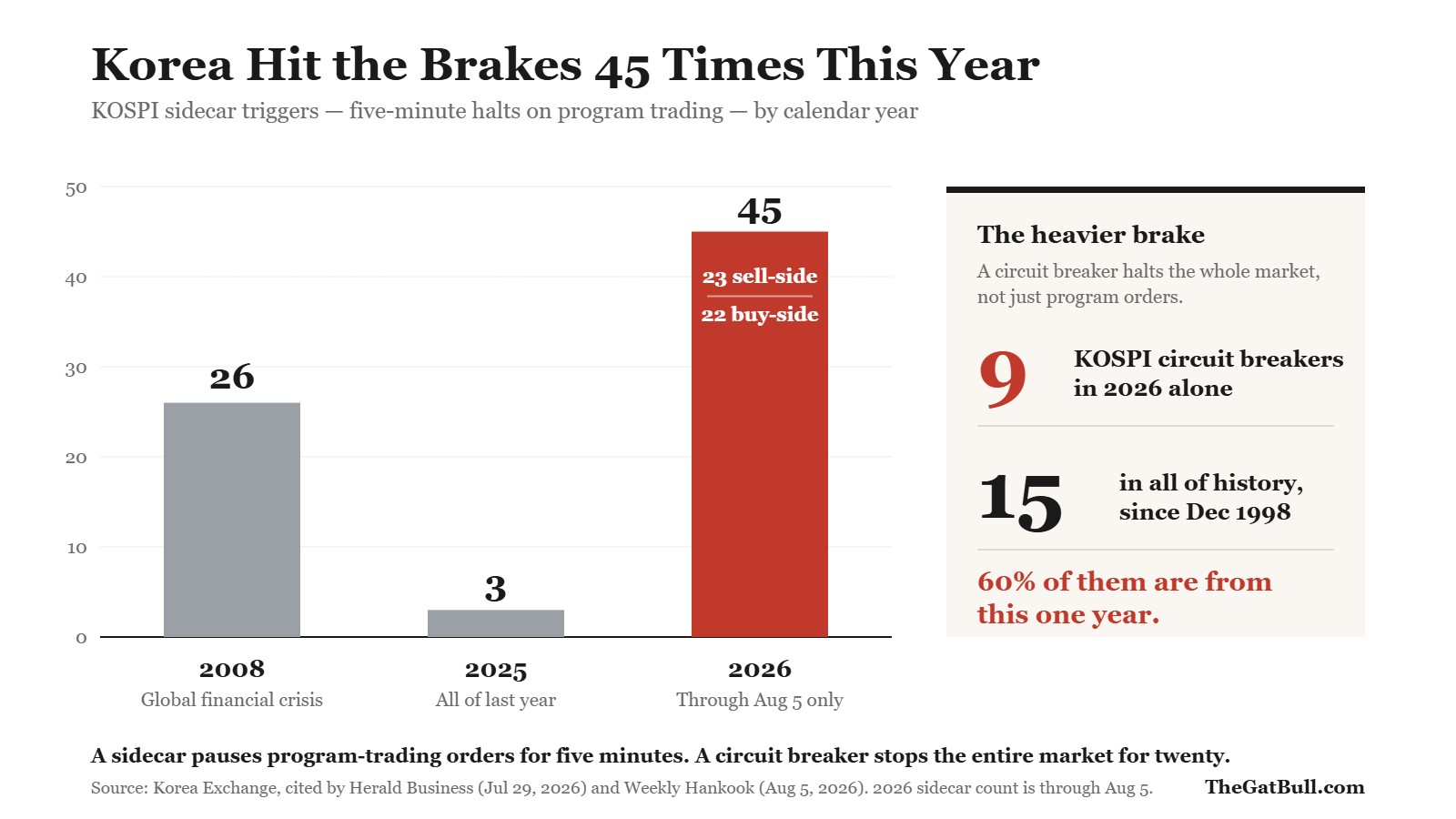
At 9:24 this morning in Seoul, twenty-four minutes after the opening bell, the Korea Exchange froze program-trading buy orders on the KOSPI for five minutes. The device is called a sidecar, and this was its 45th trigger of 2026 — 23 on the sell side, 22 on the buy side. For scale: in 2008, the year of the global financial crisis, this brake was pulled 26 times in twelve months. Last year it was pulled three times. And today’s 45th came not in a crash but inside a 3.76% rally.
If you trade from a US account, none of that will read the way a Korean investor reads it. So here is the whole system in one place: what stops trading in Korea, how often, and whether 45 is a number to be alarmed by.
What an American reader already knows: brakes are for catastrophes
US trading halts are a product of the 1987 crash. If the S&P 500 falls 7%, 13% or 20% intraday, the whole market stops. At the single-stock level, Limit Up-Limit Down bands catch violent ticks. But the market-wide circuit breaker has essentially been dormant — the last stretch anyone remembers is four days in March 2020. To a US reader, a trading halt means something has gone badly wrong in the world.
Carry that instinct to Seoul and 45 looks like a catastrophe count. It isn’t. Korea’s braking system has a different architecture: three layers instead of one, and two of the three can be tripped by prices going up.
The bridge: three brakes, not one
Layer 1 — the sidecar (the light one)
When KOSPI 200 futures move 5% from the previous close and hold there for one minute, program-trading orders are suspended for five minutes. The KOSDAQ version uses a 6% futures threshold. The market never closes — only algorithmic order flow pauses. Introduced on the KOSPI in November 1996.
This morning was a textbook case: mini KOSPI 200 futures ran from a base of 998.08 to 1,049.28, up 5.12%. A minute later the exchange pulled the sidecar. Program buying at the moment of the trigger stood at ₩259.2bn (about $182M). Five minutes later it lifted automatically, and the index closed at 6,598.26, up 3.76%.
Layer 2 — the circuit breaker (the heavy one)
If the index itself drops 8%, 15% or 20%, the entire market stops — twenty minutes at the first step, then ten minutes of single-price auction on the restart. Same concept as the US version. The difference is the frequency, and this is the statistic that deserves an American reader’s attention:
Since circuit breakers were introduced in December 1998, the KOSPI has triggered one 15 times in total. Nine of those — 60% — happened in 2026.
Korea Exchange figures, as reported by Herald Business, July 29, 2026
Put the other way: in the 27 years from 1998 to the end of 2025, the KOSPI circuit breaker fired six times — in 2000 amid the US market slump and the oil spike, in 2001 after September 11, in 2020 during the pandemic. Global-catastrophe events, the American pattern exactly. Then 2026 produced nine on its own. The KOSDAQ’s record is similar: 14 all-time, four of them this year.
And on July 28 and 29, both the KOSPI and the KOSDAQ tripped circuit breakers on consecutive days — the first time that has happened simultaneously in the two markets, according to the Korea Exchange.
Layer 3 — the ±30% daily price limit (the one with no US equivalent)
No Korean stock may move more than 30% from its previous close in a single session. This is not a pause; it is a hard boundary. When SK Hynix closed at +29.95% on July 31, buyers had not run out — the rule cut the price. Single-stock leveraged ETFs get the band widened by their multiple, so a 2x product runs to ±60% (per Financial Services Commission and Korea Exchange guidance; the underlying rulebook clause is not something we have verified directly). On July 31 a 2x SK Hynix product closed at +59.93% and its inverse at −59.95% — the band, measured.
Under the Gat. Read 45 as a fear gauge and you have read half of it. Look at the split: 23 sell-side, 22 buy-side. This year the Korean market has stopped on the way up almost as often as on the way down. A brake count is not a record of direction. It is a record of speed.
Our yard: the 2026 count, all of it
| Device | What it stops | Trigger | 2026 count | For comparison |
|---|---|---|---|---|
| Sidecar (KOSPI) | Program orders, 5 min | Futures ±5%, held 1 min | 45 — 23 sell, 22 buy (through Aug 5) | 26 in all of 2008 · 3 in all of 2025 |
| Sidecar (KOSDAQ) | Program orders, 5 min | Futures ±6% | 30 — 17 buy, 13 sell (through Aug 4) | 19 in 2008, the previous record |
| Circuit breaker (KOSPI) | The entire market, 20 min | Index −8% / −15% / −20% | 9 — against 15 in all of history | 6 in the 27 years from Dec 1998 to end-2025 |
| Circuit breaker (KOSDAQ) | The entire market | Same | 4 — against 14 all-time | First-ever back-to-back days with the KOSPI, Jul 28–29 |
| Price limit | Every stock, all session | ±30% from previous close (leveraged ETFs: × the multiple) | Binding — e.g. SK Hynix +29.95%, Jul 31 | No US equivalent exists |
Sources for the counts are Korea Exchange figures reported in the Korean press. One claim in that reporting we have not confirmed at source: that the KOSDAQ’s three consecutive buy-side sidecars on July 31, August 3 and August 4 were a first in that market’s history. Korean outlets state it; we could not verify it against the exchange directly, so treat it as reported rather than established.
One density statistic captures July better than any count: of 20 trading days in the month, 14 had a sidecar.
Why 2026 outpaces 2008
The straightforward answer: the market really was that violent. July closed down 22.19% on the KOSPI — the third-worst month since 1997 — and the final day of that same month produced the largest single-day gain on record, +17.91%. When a month contains both, index futures cross ±5% in both directions repeatedly. The brakes did what they were built to do.
The structural answer: Korean analysts point to single-stock leveraged ETFs, program trading and expanded margin lending as the amplifiers behind the volatility (attributed to Heungkuk Securities analyst Lee Young-won, in July reporting — an analyst view, not an official finding). Layer on the concentration problem: Samsung Electronics and SK Hynix together were 51.22% of KOSPI market capitalisation at the July 31 close. When two stocks are half the index, they move the futures, and the futures pull the sidecar. We took that concentration apart in You Didn’t Buy ‘Korea’ — You Bought Two Memory Stocks.
Regulators moved too: on July 29 a per-investor cap on single-stock leveraged ETF exposure was announced, part of a wider response we logged in what Seoul actually said about the currency and the leverage.
Under the Gat. Korean retail investors do not treat “sidecar” as a news word. It is ordinary vocabulary — the sort of thing that appears in a lunchtime message board post with no article attached. When a technical halt mechanism becomes everyday slang, that tells you what counts as normal operating volatility in this market.
Is a market that stops this often a broken one?
The designer’s case. A sidecar cools a five-minute pile-up in algorithmic order flow. Firing often means the mechanism is engaged, not that it has failed. Trading continued through every one of those 45 triggers, and plenty of the days that carried them — today included — closed higher.
The trader’s case. A five-minute pause delays price discovery; it does not prevent it. July 28 to 30 is the evidence: brakes fired on all three days, and the market fell on all three (−10.84%, −5.98%, −1.23%). Stopping did not change direction. And a ±30% limit does not absorb volatility so much as postpone it — the SK Hynix demand that hit the ceiling in Seoul on July 31 reappeared as a premium on the US ADR, which we traced in the anatomy of July 31.
Both cases rest on real data. Which one matters depends on your holding period: to a day trader the pause is friction, to a long-term holder it is noise.
Today’s ledger — and a number worth sitting with
August 5, 2026, KRX main-session closes: KOSPI 6,598.26 (+3.76%) · KOSDAQ 799.59 (+2.42%, a fourth straight advance) · Samsung Electronics ₩246,000 (+2.50%) · SK Hynix ₩1,668,000 (+5.77%) · USD/KRW 1,424.5 at the 15:30 Seoul fix. Foreign investors were reported to have bought a net ₩1.45tn (about $1.02B), though the reporting does not state whether that figure covers the main session only. Overnight, SK Hynix’s ADR rose 8.17% on the US Tuesday session, and Seoul opened into that gap — which is what pulled this morning’s sidecar.
Now the number. The KOSPI closed July 31 at 6,595.45. It closed today at 6,598.26. Between those two prints it fell 5.12%, rose 1.62%, and rose 3.76% — more than ten percentage points of movement in absolute terms.
Net change over the three sessions: +0.04%.
That is the argument of this entire article in one line. The braking system was busy. The index went nowhere. Brakes record speed, not direction.

The takeaway
The real question in 2026 is not “why did the market stop 45 times.” It is what is driving the market at this speed — half the index capitalisation sitting in two stocks, leveraged products layered on top, and program orders running across both. The brake count is a thermometer for that structure. There is not much point blaming the thermometer.
FAQ
What is a sidecar in the Korean stock market?
It is a Korea Exchange mechanism that suspends program-trading orders for five minutes when KOSPI 200 futures move 5% or more from the previous close and hold for one minute. The KOSDAQ threshold is 6%. The market itself stays open — only program orders pause. It was introduced on the KOSPI in November 1996.
How is a sidecar different from a circuit breaker?
A circuit breaker stops the entire market when the index itself falls 8%, 15% or 20%, halting trading for twenty minutes at the first level. A sidecar is triggered by futures, pauses only program trading, and lasts five minutes. It is far lighter, which is why it fires far more often. A sidecar can also be triggered by a rally; the circuit breaker is a downside mechanism.
Does the US have anything equivalent?
Partly. The US has market-wide circuit breakers on the downside and Limit Up-Limit Down bands on individual stocks. It has no futures-triggered halt on program trading, and no fixed daily price limit per stock. The US market-wide breaker has not been triggered since March 2020.
Why were there so many halts in 2026?
July alone contained both the third-largest monthly decline since 1997 (−22.19%) and the largest single-day gain on record (+17.91%). Add expanded single-stock leveraged ETFs, heavy program trading, and the fact that two stocks made up 51.22% of KOSPI market capitalisation, and index futures crossed the 5% threshold repeatedly in both directions.
Do frequent halts mean a crash is coming?
Not by themselves. Of the 45 sidecar triggers in 2026, 22 were on the buy side — halts caused by prices rising. The count measures volatility, not direction. What it does confirm is that volatility is at a historic level, which matters most to holders of leveraged products, where the daily band widens with the multiple.
Sources
- Herald Business, July 29, 2026 — circuit breaker and sidecar counts attributed to the Korea Exchange: biz.heraldcorp.com
- Weekly Hankook, August 3–5, 2026 — sidecar trigger reports citing Korea Exchange announcements
- Newspim, July 29, 2026 — first simultaneous back-to-back circuit breakers on the KOSPI and KOSDAQ
- Herald Business, August 5, 2026 — closing market report; Financial News, August 5, 2026 — won close at the 15:30 Seoul fix
- Financial Services Commission — investor guidance on single-stock leveraged ETFs and ETNs (price-limit widening)
- Yahoo Finance — daily closes for ^KS11, ^KQ11, 005930.KS and 000660.KS (KRW, KRX, Asia/Seoul)
Not financial advice. TheGatBull does not recommend buying or selling any security. Prices are KRX main-session closes; the won rate is the 15:30 Seoul close of ₩1,424.5 per dollar on August 5, 2026. Investment decisions and their consequences are your own.